
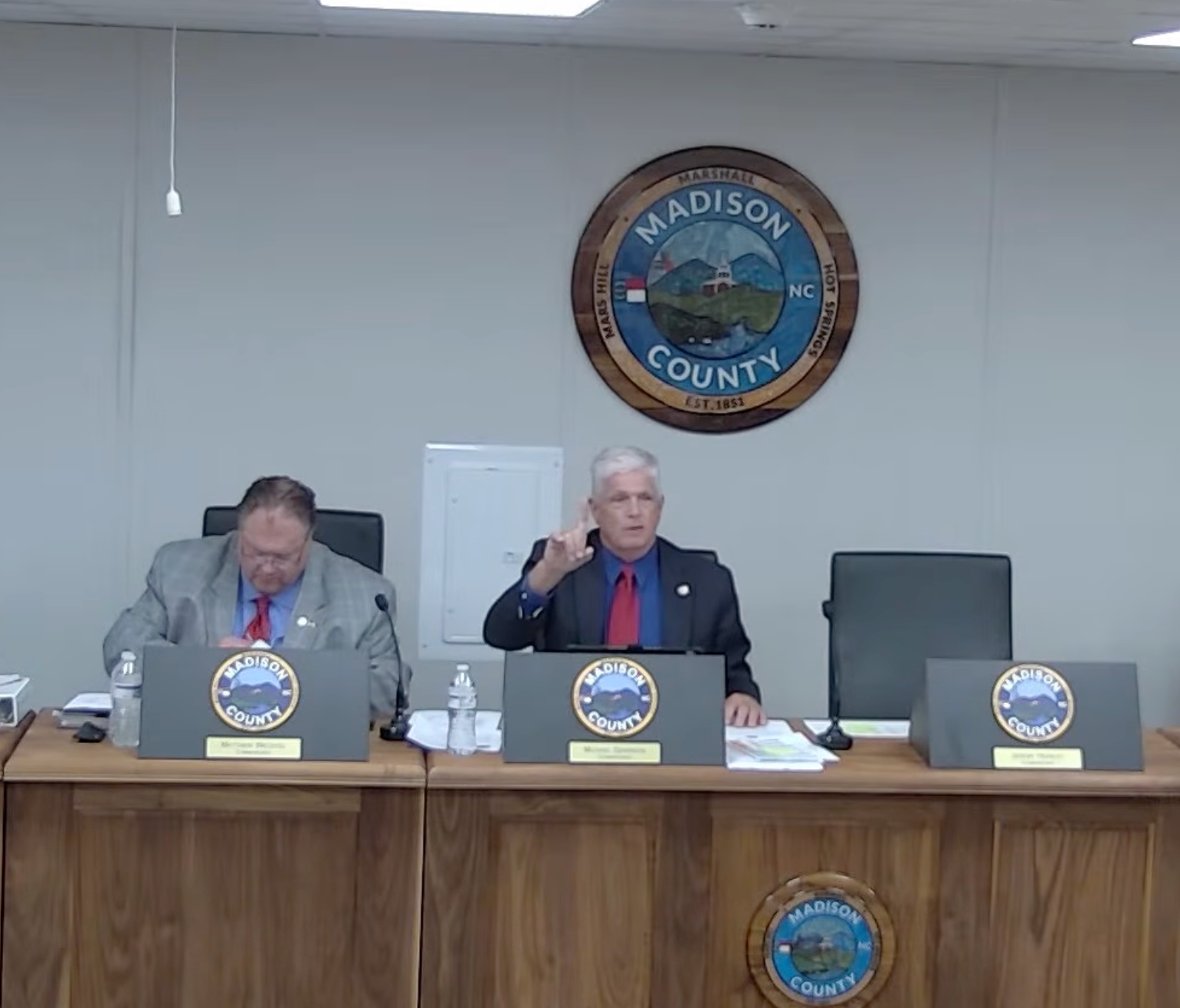
A County Commissioner in North Carolina refused to let dozens of residents speak opposing Flock surveillance at a public meeting this week, instead forcing the group to designate one single spokesperson.
“How many people are here for public comment dealing with license plate readers AKA Flock?,” Michael Garrison, the chairman of the Madison County Board of Commissioners began the public meeting by saying. Nearly everyone in the audience’s hand went up. “Probably most everybody. Per our county policy, I’m going to respectfully ask that you guys take a few minutes to converse with each other, designate one person to speak … we’ll move forward with only one person, whoever that happens to be.”
“What? No. We all want to speak on this,” someone in the crowd said; others can be heard trying to object as well.
“You will not speak on Flock tonight,” he responds. “One person designated. You can pick that person … if I gave everyone three minutes to say the same thing, which is opposition to Flock, we’d never get done … I’ve spoken. I’m not debating this. I am taking advantage of our policy as it is written to streamline this process, you can either do it or not.”
“You’re in a room full of people who care!,” a person in the crowd says.
“We’re not going to engage in this back-and-forth conversation,” he responds. “We’re going to allow one person. Pick a person or not.”
The Madison County Sheriff’s Office has been using Flock’s automated license plate readers, which scan and analyze the time and location of cars as they drive by, since at least March, according to a Facebook post by the Sheriff’s Office. Records compiled by HaveIBeenFlocked.com based on public records requests show that the Sheriff’s Office searches Flock hundreds of times per month. Over the last year, citizen privacy groups have successfully pressured their local governments into ending contracts with Flock. But in some cities and municipalities, residents feel like their concerns have been ignored.
“The Sheriff Office claims they are only using this technology for serious crimes, yet published audit logs tell a different story,” a website called Madison for Privacy says. “Madison County has searched the nationwide database over 1,200 times over just a 60 day period. In a county over only 20,000 residents, its hard to understand what could warrant this many searches.”
Members of the audience and several of the commissioners then argued back and forth. The commissioners said that the citizens constituted a “group” who all had the same position, and therefore could only select one representative to speak for seven minutes, which the board said was longer than the three minutes each person would normally be allowed to speak for. Residents argued that they were not a “group” but were there to give different perspectives on the issue and that they were concerned about the surveillance as specific individuals: “I’m not here as a group, I’m an individual,” one person says.
“I’m not here to argue with you,” a commissioner responds.
“So you’re going to decide to not listen to your citizens, that’s what you’re saying,” a woman in the crowd says.
“We’re going to follow the policy,” the commissioner responds.
“Can we request that there be a special meeting,” about Flock, a resident says.
“If you want a special meeting, you go back to the 250 years that the sheriff has been the elected official in the state of North Carolina and you have that meeting with him. This board, we don’t own Flock cameras, I’ve emailed some of you this. We don’t pay for Flock cameras. We don’t operate Flock cameras. We have no interest in Flock camera or Flock camera discussion. That’s your elected sheriff. So if you want to have a meeting with the person that’s involved with that, then you’ll have a meeting with [him], not with us that’s a legislative body. We don’t control the sheriff’s budget. We give him X number of dollars, he does with it what he wishes. I’m not having this discussion. Either you select a person or not.”
One of the residents suggests that the board of commissioners could pass an ordinance about Flock cameras; he is cut off by Garrison, who says again that the residents can pick a person to speak or not. Eventually, the residents do select one representative, who was allowed to speak for seven minutes.
Garrison’s argument is that the Board of Commissioners gives the Sheriff’s Office a budget, and that the Sheriff can spend the money on whatever it wants to. He suggested that the board therefore does not have oversight of what surveillance technology police are buying or what they are using it for. This fact highlights a problem many communities around the country are facing: Cities and counties are sometimes buying Flock surveillance technology without any transparency, with no public process, and with very little oversight. Citizens around the country have also felt like their elected officials are not listening to their concerns about surveillance.
It is common practice at city council and county council meetings to allow all residents who have shown up to speak provide public comment, which is one of the reasons that these types of meetings are often many hours long. At the Madison County meeting, these residents were not allowed to speak, which is much different than the practices we’ve seen at other, similar meetings.
Later in the meeting, another resident explains that their public records requests for details about the Sheriff’s Office contracts and use of Flock have not been sufficiently responded to. She was allowed to speak because she was providing comment about her requests for public records, and not Flock specifically. “I’m here to talk about the lack of government transparency and accountability that I’ve seen come up with the Flock issue, starting with tonight. I think that it’s disgraceful the way you are refusing to let citizens speak to their elected officials,” she said. “We’ve repeatedly asked you to hold a public meeting for us to discuss this, so I’m very disappointed to see a lack of transparency.”
The Madison County Board of Commissioners and Madison County Sheriff’s Office did not respond to a request for comment.