
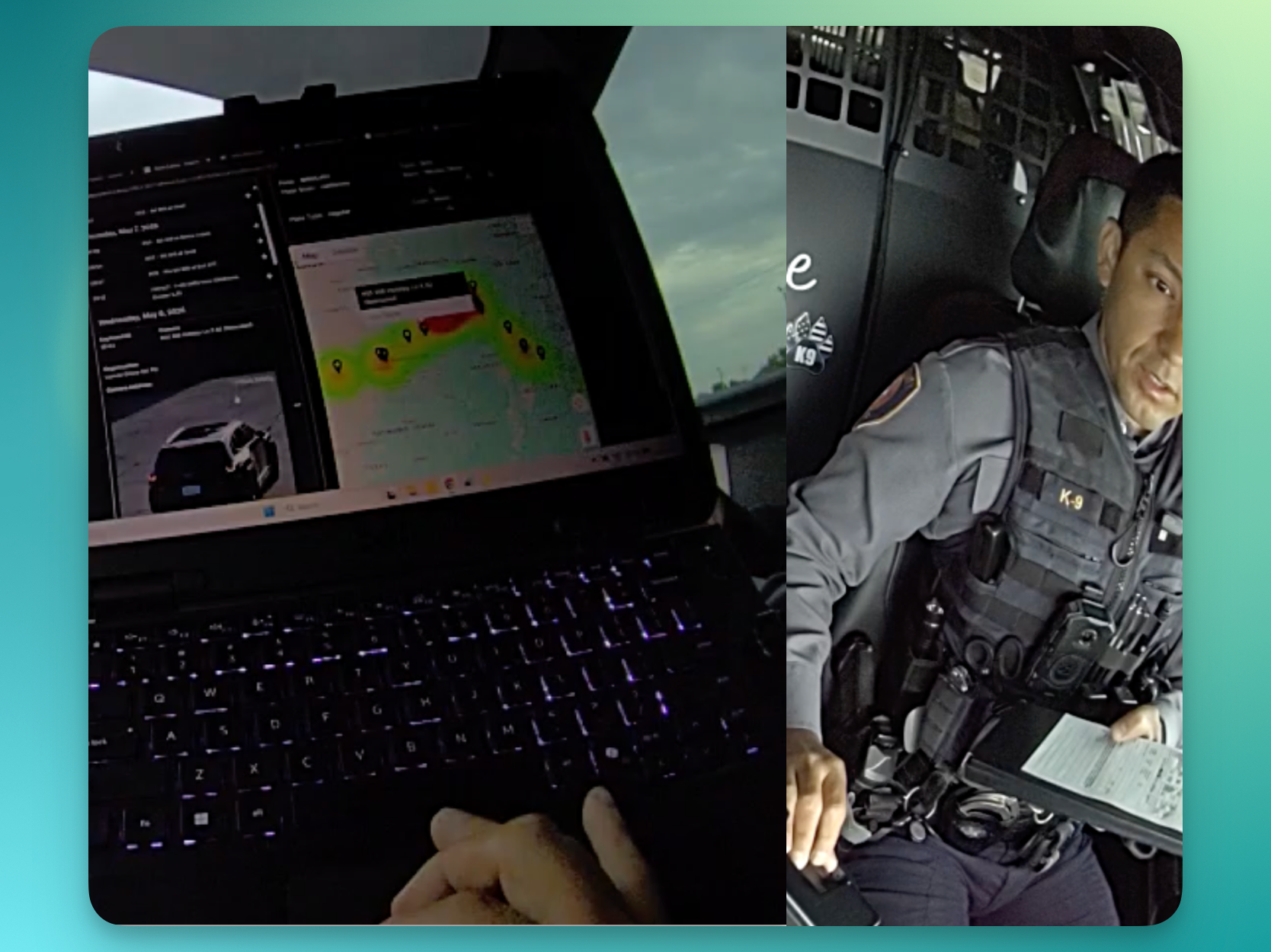
Body camera footage obtained by 404 Media reveals the first Flock camera searches ruled unconstitutional by a federal judge, and highlights how the system has turned otherwise mundane traffic stops into interrogations for drivers.
On Friday, we reported that a federal judge ruled the use of license plate reader systems in the arrest of a woman named Melissa Kyle to be an “unconstitutional warrantless search,” “indiscriminate mass surveillance,” and a violation of the driver’s Fourth Amendment rights. The judge in that case ruled that, even though Kyle had more than 91 pounds of meth in her vehicle, the police had no justifiable reason to search Flock for her license plate and no reason to suspect that her travel as shown on Flock’s system was suspicious. Therefore, all of the evidence from Flock and the search of her vehicle must be thrown out.
The body camera and in-vehicle footage, alongside records from Flock and the Motorola ALPR system obtained by 404 Media shows how the use of license plate reader systems is being used to create probable cause where a person’s driving patterns are suspicious enough to pull them over.
404 Media obtained the footage with the help of one of our readers, who agreed to go to the U.S. District courthouse in Tulsa and purchase it from the clerk; the court did not make the footage available online even though it was entered as evidence in the case.
In the footage, which is from Tulsa County deputy sheriff Freddie Alaniz’s body camera, Alaniz is seen driving 60 miles per hour, one hand on the steering wheel, one hand on his laptop, searching Flock before he had even fully pulled over Alaniz. Alaniz had seen the car Kyle was driving had California license plates, and decided to pull it over for no reason other than it was from California, the court determined. The video shows that Alaniz told his colleagues that he was sitting on the highway and “saw her go by, and I just started running her info on Flock and Vigilant [Motorola’s ALPR system].”
“She actually didn’t have any [Flock] hits until just west of Amarillo, [Texas], so I thought I’d drive up,” he said, suggesting that he thought it was odd she was driving back from California. “I got her for a lane violation.”
In the footage, Alaniz tells Kyle he pulled her over ostensibly for changing lanes without a turn signal. Kyle tells Alaniz that the car is a rental, and he asks her to step out of the vehicle and get into his car while she looks up the rental information. While she is looking up the rental information, he tells her she is only going to get a warning, but proceeds to interrogate her about the travel while going through the car’s driving history on his in-car laptop.
Body camera footage obtained from the court
In-car footage obtained from the court
Kyle told Alaniz she had been visiting family in California from Missouri for a few days after separating from her husband. As she’s telling him this, Alaniz scrolls through a record of her travel history on his in-car laptop, which documents every time the car passed a Flock or Motorola automated license plate reader camera over the last 30 days. Visible on the screen, there are a total of 79 hits, and roughly 50 during the few-day period Kyle was renting it. The ALPR hits show the car leaving Missouri, driving through Oklahoma, Texas, New Mexico, Arizona, and entering California when she passed a Motorola ALPR camera in Topock, Arizona, on the border with California. They then show her essentially reversing the route, and driving back through Oklahoma. (Alaniz did not have access to ALPR hits from California; this may be because Flock drastically limited nationwide sharing from California ALPR cameras following illegal searches for immigration violators and a woman who had an abortion.)
Alaniz asks Kyle where she’s been and where she stayed, and compares it to the license plate camera records. He begins quizzing her: “Do you remember what day you left Missouri?,” he asks.
Alaniz clicks different ALPR hits on his map, each bringing up a photo of her car, a geographic location, and a timestamp of when she drove by the camera. The government’s lawyers later argued in court that minor discrepancies between what Kyle told Alaniz and what the ALPR data showed meant she was lying about where she’d been on which specific days and therefore gave Alaniz probable cause to search her vehicle.
Alaniz tells Kyle that he is giving her a warning for changing lanes without a turn signal, closes his laptop, then says he wants to ask her a few questions.
“Your short trip to California, I feel like. I don’t feel, I know from my training and my experience that people who do very short trips to California and come right back are transporting large amounts of drugs,” he says. “People who do that—not everybody, but some people do. With my training and experience, I feel that may be something going on here. May I search your car?”
She says no. Alaniz calls for backup, and says “You are being detained. You are not free to go.” In the footage, Alaniz tells a colleague that “she went to California for two days, kind of making stuff up when I ask her where she stayed at.”
He used Alaniz’s travel history, her “nervousness,” and the fact that she doesn’t recall every detail of her travel precisely as probable cause to search her vehicle, where he and his colleagues found 91 pounds of meth. Alaniz described this in the footage as “a motherlode,” and “a shit-ton of meth.”
But the way that he came to this conclusion was unconstitutional, U.S. District Court Judge Sara Hill ruled last week, and all of the evidence—including the car’s travel history and everything the police found during the search of the vehicle—must be disregarded in court as “fruit of the poisonous tree.”
It is often the case that unconstitutional, privacy-violating searches that are regularly done on everyday people doing nothing wrong are discovered in court cases in which serious crimes have occurred. In this particular case, Alaniz discovered what appeared to be meth trafficking, but he did so only after suggesting that an ordinary interstate travel pattern was somehow suspicious, and only after using the Flock and Motorola systems to show an incredibly detailed history of a person’s travel and to interrogate her about it.
Hill wrote “The factors that the government relies upon [to search Kyle’s vehicle] are the same type of circumstances that everyday Americans encounter on long road trips for many legitimate reasons. Many of us drive longer than we want to get to a desired destination, or to no destination at all other than the road and sights ahead. Many of us lose track of what exact day of the week it is when we are traveling, even if it is for just a moment. Many of us travel for myriad reasons (some better than others), cross state lines, pack too much, buy too much, smoke cigarettes, and rent cars. And many of us even get a bit nervous when talking to law enforcement.”
One of the problems with automated license plate reader systems is that they allow police to recreate not just a single person’s movements and travel history, but any driver’s movements and travel history. Documents filed with the court show the totality of both the Flock and Motorola records, and show timestamped, geographically mapped images of the vehicle multiple times per day, driving throughout the entire country. The records also highlight just how many jurisdictions and businesses have Flock and Motorola ALPR cameras, and how that data forms a nationwide network.
For example, Alaniz had access to a photo of the rental vehicle taken by a Lowe’s hardware store-owned camera in Missouri, various Texas state police-owned cameras, by the New Mexico State police, the Kingman police department. In a five-day period, the car was scanned more than 50 times by 11 different law enforcement agencies.
“Alaniz’s search in just the ALPR system provided him with more than 50 individual records of Kyle’s whereabouts across the country for an entire month,” Hill wrote. “The Court finds that because the ALPR systems Alaniz used to search Kyle’s historical location information intruded on her reasonable expectation of privacy in the whole of her physical movements, it was a search under the Fourth Amendment. Based on the information in the record, the only reason Alaniz conducted that search was because he saw her license plate was from California. That search was not supported by probable cause, and it was done without a warrant in violation of Kyle’s Fourth Amendment rights.”
The Motorola ALPR report shows that, after the car was impounded, it was scanned two more times on the back of a tow truck later that day.