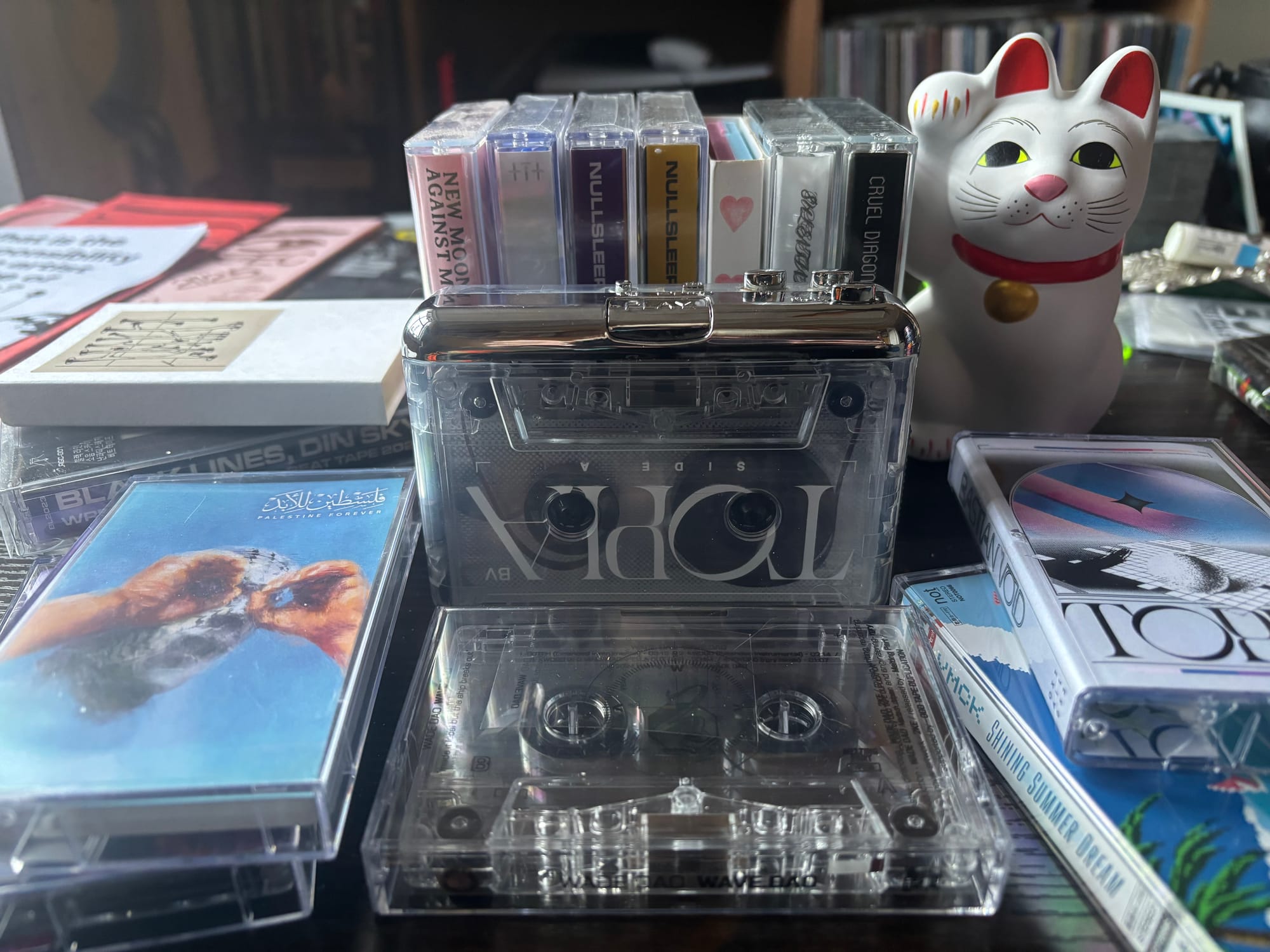
Whenever I tell people I’m getting back into tapes, their faces immediately light up.
There’s a genuine excitement in peoples’ expressions these days when I mention physical media. Lately I’ve been talking about the cheap walkman I bought on a recent trip to Tokyo, and the various little shops where I hunted for music on cassettes. Unlike in Europe and the US, physical media never went out of vogue in Japan, and many people still have a strong preference for shopping in-person. This made Tokyo the ideal place to rediscover my love of portable analog music.
I searched through racks of tapes stacked on top of an old piano in a back-alley store on the edge of Shimokitazawa, a neighborhood known for thrifted fashion and oddball record shops. On recommendation from a friend-of-a-friend, I checked out a specialist shop on a sleepy street in Nakameguro, where cassettes easily outnumbered vinyl records 10-to-1. Almost always, I steered myself toward local artists whose names I didn’t recognize. Sometimes, I bought tapes based on the cover art or description alone. Most second-hand music stores in Tokyo keep everything sealed in plastic, so you either have to bother the shopkeep, or just trust your gut and take a chance.
This kind of music discovery delights people when I describe it to them. Sometimes they start telling me about rediscovering their old CD collection, or wanting to track down an old iPod Classic to experience their music library away from the surveillance and excess of big tech platforms. Maybe it’s just because I live in a particular social bubble in a particular countercultural pocket of New York City. But recently, the conversations I’ve had on this topic have got me feeling like the culture of music is shifting.
People are leaving Spotify, and those who aren’t seem embarrassed about using it. Major artists pulled their music off the platform this year in protest of the company’s ICE recruitment ads and connections to military drones, and posting your Wrapped stats has gone from a ubiquitous year-end pastime to a cultural faux pas. Many folks are sick of streaming in general. They’re sick of giant corporations, algorithmic playlists, and an internet infested with AI slop. Artists are tired of tech platforms that pay them virtually nothing, owned by degenerate billionaires that see all human creativity as interchangeable aesthetic wallpaper, valued only for its ability to make numbers go up. Everywhere I go, people are exhausted by the never-ending scroll, desperately wanting to reconnect with something real.
My own path to re-embracing physical media unfolded in stages. Last year, I canceled my Apple Music subscription and started exclusively listening to music I bought from artists on Bandcamp. I still have a large mp3 library, and I thought about setting up a self-hosted media server to stream everything to my phone. But ultimately, I got lazy and wound up just listening to albums I downloaded from the Bandcamp app. Then I ran out of storage on my phone, and the amount of music I had available on-the-go shrank even more.
When I came to Tokyo, a friend took me to a store that sold cheap portable cassette players, and I knew it wouldn’t be a huge leap to take my music listening fully offline. The walkman I bought is unbranded and has a transparent plastic shell, allowing you to watch all the little mechanical gears turning inside as the tape spools around the wheels and past the playheads. It was one of the easiest purchasing decisions I’ve made in recent memory: After years of psychic damage from social media and other phone-based distractions, I was ready to once again have a dedicated device that does nothing but play music.
There are lots of advantages to the cassette lifestyle. Unlike vinyl records, tapes are compact and super-portable, and unlike streaming, you never have to worry about a giant company suddenly taking them away from you. They can be easily duplicated, shared, and made into mixtapes using equipment you find in a junk shop. When I was a kid, the first music I ever owned were tapes I recorded from MTV with a Kids’ Fisher Price tape recorder. I had no money, so I would listen to those tapes for hours, relishing every word Kim Gordon exhaled on my bootlegged copy of Sonic Youth’s “Bull in the Heather.” Just like back then, my rediscovery of cassettes has led me to start listening more intentionally and deeply, devoting more and more time to each record without the compulsion to hit “skip.” Most of the cassettes I bought in Tokyo had music I probably never would have found or spent time with otherwise.
Getting reacquainted with tapes made me realize how much has been lost in the streaming era. Over the past two decades, platforms like Spotify co-opted the model of peer-to-peer filesharing pioneered by Napster and BitTorrent into a fully captured ecosystem. But instead of sharing, this ecosystem was designed around screen addiction, surveillance, and instant gratification — with corporate middlemen and big labels reaping all the profits.
Streaming seeks to virtually eliminate what techies like to call “user friction,” turning all creative works into a seamless and unlimited flow of data, pouring out of our devices like water from a digital faucet. Everything becomes “Content,” flattened into aesthetic buckets and laser-targeted by “perfect fit” algorithms to feed our addictive impulses. Thus the act of listening to music is transformed from a practice of discovery and communication to a hyper-personalized mood board of machine-optimized “vibes.”
What we now call “AI Slop” is just a novel and more cynically efficient vessel for this same process. Slop removes human beings as both author and subject, reducing us to raw impulses — a digital lubricant for maximizing viral throughput. Whether we love or hate AI Slop is irrelevant, because human consumers are not its intended beneficiaries. In the minds of CEOs like OpenAI’s Sam Altman, we’re simply components in a machine built to maintain and accelerate information flows, in order to create value for an insatiably wealthy investor class.
On one hand, I empathize with those who still feel like they get something out of streaming. Having access to so much music can feel empowering, especially when so many people feel like they lack the time and resources to develop a music-listening practice. “What streaming service should I use instead of Spotify?” is a question I’ve been seeing constantly over the past few months.
Here’s my contrarian answer: What if there’s no ethical way to have unlimited access to every book, film, and record ever created? And moreover, what if that’s not something we should want?
What if we simply decided to consume less media, allowing us to have a deeper appreciation for the art we choose to spend our time with? What if, instead of having an on-demand consumer mindset that requires us to systematically strip art of all its human context, we developed better relationships with creators and built new structures to support them? What if we developed a politics of refusal — the ability to say enough is enough — and recognized that we aren’t powerless to the whims of rich tech CEOs who force this dystopian garbage down our throats while claiming it’s “inevitable?”
Tapes and other physical media aren’t a magic miracle cure for late-stage capitalism. But they can help us slow down and remember what makes us human. Tapes make music-listening into an intentional practice that encourages us to spend time connecting with the art, instead of frantically vibe-surfing for something that suits our mood from moment-to-moment. They reject the idea that the point of discovering and listening to music is finding the optimal collection of stimuli to produce good brain chemicals.
More importantly, physical media reminds us that nothing good is possible if we refuse to take risks. You might find the most mediocre indie band imaginable. Or you might discover something that changes you forever. Nothing will happen if you play it safe and outsource all of your experiences to a content machine designed to make rich people richer.