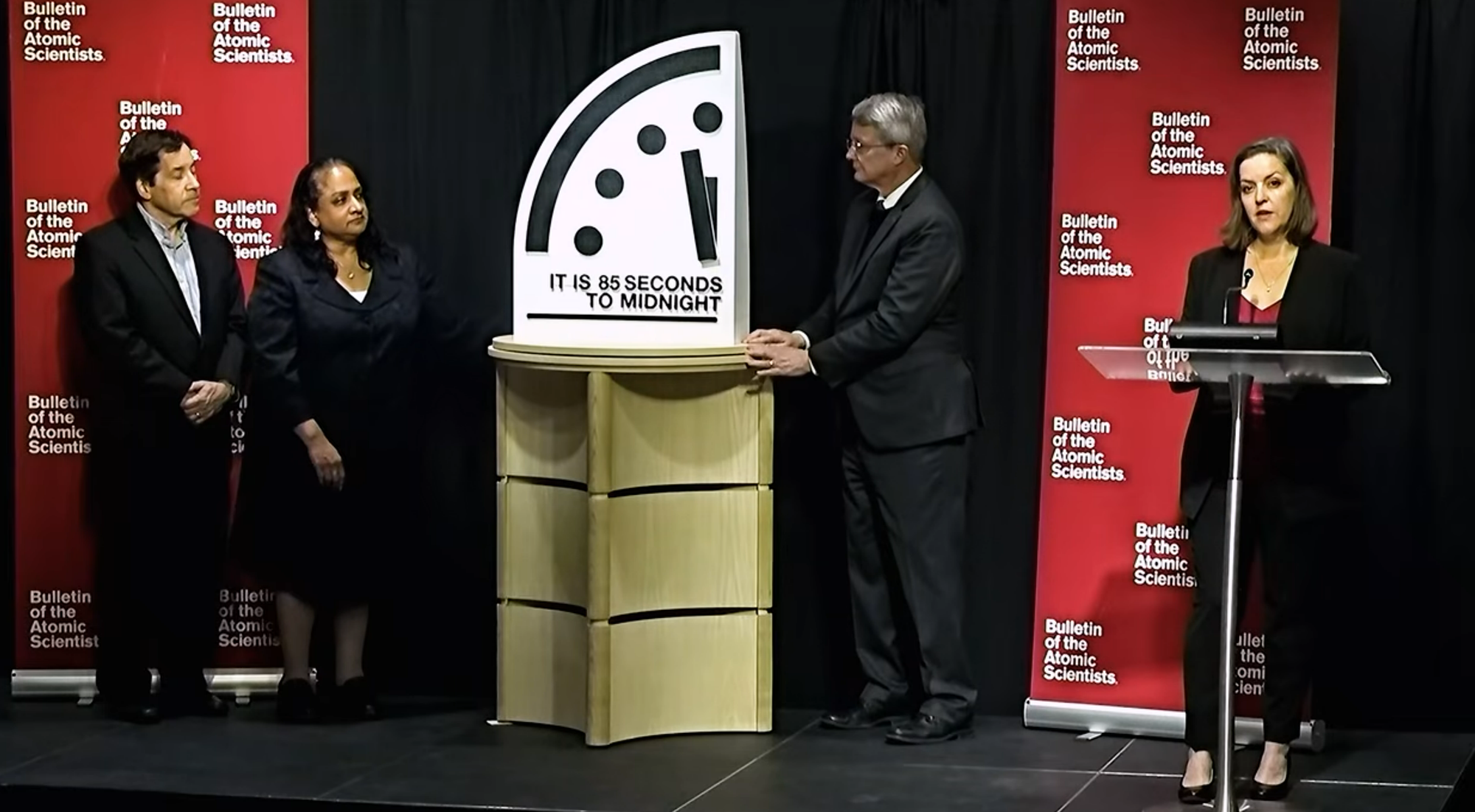
The Doomsday Clock, a symbol of how close humanity is to destroying itself, has moved from 89 seconds to 85 seconds, four seconds closer to “doomsday.” That is the closest the Clock has ever been to midnight. That’s when, in the metaphor proposed by the keepers of the Clock, the world ends. According to the scientists and experts who oversee the ritual setting of the Doomsday Clock, the end of the world is more possible now than it’s ever been.
But In 2026, I feel I don’t need the reminder.
President Donald Trump’s masked police have executed people in the street, the last nuclear treaty between Russia and the US is about to die, and tech oligarchies are constructing massive resource-sucking datacenters to power an unwanted nuisance technology they say is a path towards a godlike super intelligence.
Why watch the Clock? What is the point of keeping time? I have watched this ritual timekeeping for a decade and, I confess, I am feeling numb and cynical about it.
The Doomsday Clock began ticking in 1947, two years after Albert Einstein and a group of Manhattan Project veterans founded the Bulletin of the Atomic Scientists, the organization that sets the clock. For almost eight decades, generations of the world’s brightest minds have gathered once a year to tell the world how screwed it is.
Alexandra Bell, the current head of the Bulletin, said The Doomsday Clock is worth preserving, of course. Bell describes herself as a late stage Gen Xer. The Clock, she told me in a call last week, has always been a part of her life. “One of every four movies on TV was a nuclear one,” she said. The clear and iconic lines of the Clock have been present in pop culture for decades, most noticeably as a thematic image in Alan Moore’s Watchmen comic book. According to Bell, the symbol is important. “It’s clear that people respond to it. If you simply had a set of scientists deliver a statement about the state of existential risks…would it have the same global reach that the Clock does?”
Nuclear expert Joseph Cirincione also doesn’t recall a time when the Doomsday Clock wasn’t ticking away in the background of his life and work. “It’s part of the fabric of the nuclear age,” he said. Cirincione worked on military reform as a Congressional staffer for nine years before starting a long career in the nuclear world. He’s the former director of non-proliferation at the Carnegie Endowment for International Peace and the retired president of the Ploughshares fund.
Cirincione wasn't exactly skeptical of the Clock when I spoke to him the day before the announcement. “The Doomsday Clock is probably the most cited measure of nuclear risk in the world today,” he said. But he did share some of my concerns. “Being so close to midnight, you’re afraid the metric loses its power,” he said.“What does it mean to go from 89 seconds to 75 seconds?”
“Here's the dilemma: I believe we are seconds away from nuclear catastrophe,” he said. “This is true. This is an accurate reflection of the risk. You can make a long list of what the risks are, but at the top of the list is that a crazy man has the sole unfettered ability to launch a nuclear war, and no one can stop him, and that is our president. That is true. He could do that this afternoon. The President of the United States is increasingly demonstrably mentally unstable, and yet, if he wanted to launch a nuclear weapon, no one could stop him.”
During an interview with New York Magazine published on January 26, 2025—the day before the Clock ticked forward—Trump appeared to forget the word “Alzheimer’s” when describing the health issue that felled his father. “Well, I don’t have it,” Trump said after his press secretary filled in the word for him. “I don’t think about it at all. You know why? Because whatever it is, my attitude is whatever.”
These are not inspiring words from a man with the ability to end all life on Earth.
Cirincione wants the Bulletin to stress Trump’s diminished mental capacity during its announcement, but he’s not hopeful they will. “What holds them back is that the natural desire of experts to be non-partisan and to not explicitly criticize a leader of a country, a leader of a political party, they don't want to be dragged into that,” he said. “Discussing the mental stability of that person that is way too sensitive for a group like the Bulletin to take on. So they will shirk from that.”
During speeches and a question and answer session after the announcement, the experts at the Bulletin mentioned Trump many times. It’s clear they see him as a liar and a threat to world peace. “We’ve seen President Trump using [AI videos] to try to persuade people that things have happened that have not happened,” Steven Fetter, a member of the Bulletin’s Science and Security Board, said. But as Cirincione predicted, they didn’t touch on his mental state.
They did, however, hit on another topic Cirincione worried they would avoid. “The biggest change in nuclear risks over the last 10 years is that seven of the nine nuclear armed states are now led by authoritarian leaders,” he said.
The rising tide of authoritarianism and nationalism were central talking points of the Bulletin’s announcement this year. Nobel Peace Prize Laureate Maria Ressa gave the keynote address of the announcement. Ressa, a journalist from the Philippines, is well aware of the world’s current horrors. Ressa reported on the presidency of Rodrigo Duterte who was a kind of proto-Trump. She said that democracy, diplomacy, and science don’t work without a shared sense of reality, what she calls the world’s operating system.
“The operating system has been corrupted, deliberately, systematically, for profit,” she said during her address. “The platforms that mediate our information were built on an extractive and predatory model. They turned our attention into a commodity and our outrage into their business model…this brings out the worst of humanity. They don't connect us, they divide us, and in that division, they've enabled the collapse of cooperation and the rise of illiberal leaders who exploit chaos. As of last year, 72 percent of the world is now under authoritarian rule.”
In her address, Ressa was critical of big tech. “The old order is not coming back,” Ressa said. “We’re witnessing something more dangerous: the fusion of state power with the tech oligarchy. The men who control the platforms that shape what billions believe have merged with the men who control governments and militaries. Might makes right is the new operating principle and they have the tools to manufacture consent or to simply drown out dissent.”
In a world where the tech company Palantir works hand in glove with ICE to figure out which neighborhoods to raid and Flock’s facial recognition technology is used liberally by police across America, Ressa’s words hit the mark more closely than the threat of nuclear weapons. And maybe that’s what I’m feeling too: the sense that nuclear weapons, like the Clock, are a nostalgic fear in the face of Big Tech overreach and the rise of authoritarianism.
And yet. The United States is set to spend trillions of dollars on new and different kinds of nuclear weapons. In less than two weeks, the last remaining treaty that limits the amount of deployed nuclear weapons in America and Russia will expire. Trump has threatened to test nuclear weapons again. China is building more nukes. Multiple countries, including South Korea, have expressed interest in acquiring their own nukes.
The risk of nuclear annihilation can feel abstract and overwhelming. The world has built a series of complicated and interconnected systems that allow a handful of people to destroy everything. When facing the totality of these weapons I feel like the protagonist of a Lovecraft story. I am struck dumb by horrors beyond my comprehension.
Best, then, to keep the metaphors simple. “Other people have tried,” Cirincione said. “None of them have come close to the traction of the Clock. So, the best argument for keeping the Clock is that it works and it has a proven track record, and you'd be foolish to give up that symbol now.”
Bell said that more people are paying attention to the Clock than ever before. She tells me that traffic is up at the Bulletin’s website and more people are reading about nuclear weapons, climate change, and the existential risks of technology like AI. The Clock, Bell said, is still connecting with people. “It’s not just a warning, it’s a call to action,” she said. “The fact that it’s not midnight yet means we have time to fix these problems.”
I ask her how close the Clock has to tick down to midnight before the metaphor breaks down.
“I hope we never have to find out,” she said. “Every metaphorical second counts.”
So the Clock ticks on. Four seconds closer now.
“How long can we go? We go until midnight,” Bell said.
