
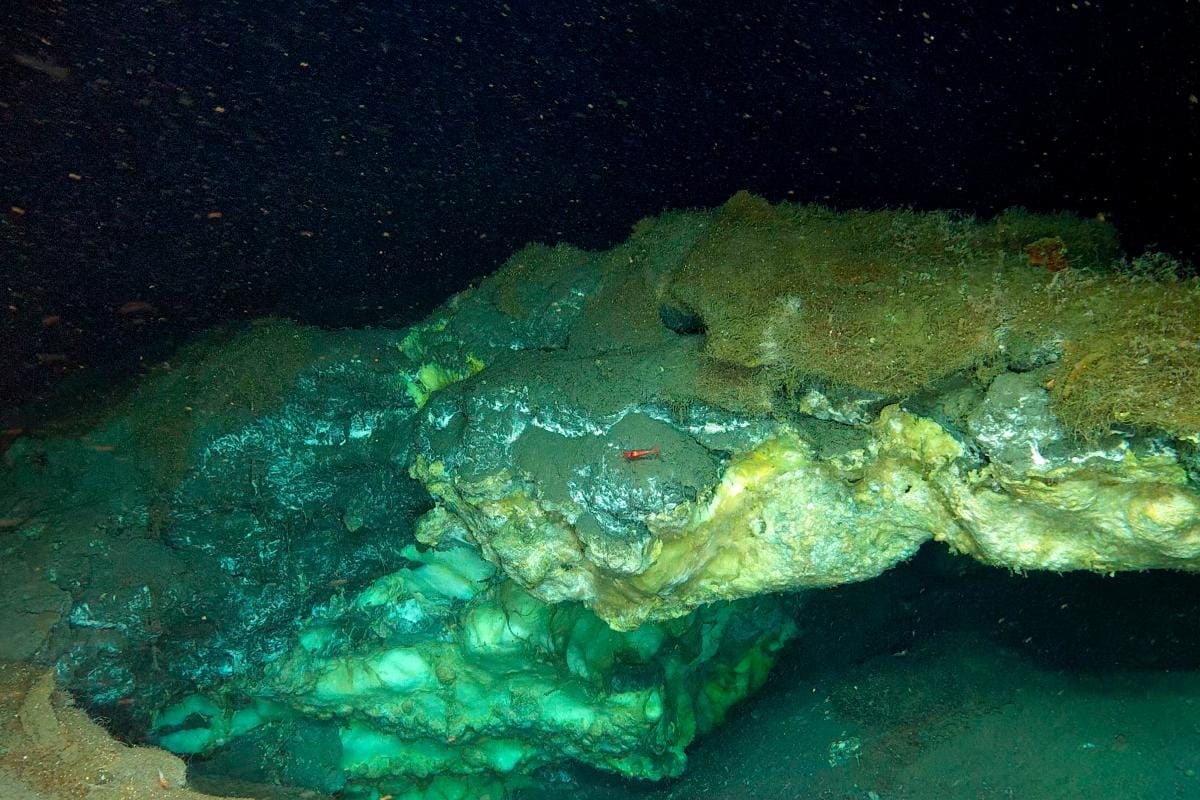
Scientists have discovered a hotspot of weird marine life more than two miles underwater in the Arctic, making it the deepest known example of an environment called a gas hydrate cold seep, according to a new study in Nature Communications.
Researchers found the thriving ecosystem some 2.2 miles under the Greenland Sea using a remote operated vehicle during the Ocean Census Arctic Deep EXTREME24 expedition in 2024. Gas hydrate seeps are patches of seafloor that releases large amounts of gasses, such as methane; the newly discovered site is more than a mile deeper than any previously documented gas hydrate.
The discovery sheds new light on these influential seeps, which play a role in the climate and carbon cycle and support chemosynthetic ecosystems that feed on seafloor gasses instead of sunlight. Giuliana Panieri, the chief scientist of the expedition and lead author of the new study, recalled yelling out with excitement when the team received the first visuals of the seafloor hotspot, which the researchers named the Freya gas hydrate mounds.
“It was crazy because we saw several of these mounds, which are filled with gas hydrates, and all the organisms living there,” said Panieri, who is a professor at University of Tromsø – The Arctic University of Norway and the director of the Italian National Research Council's Institute of Polar Sciences, in a call with 404 Media.
“What is fascinating when we have this kind of expedition is the organisms that are living down there,” she added. “At a water depth of almost 4,000 meters, you have these dense oases of organisms. I know that there are many new species. I have to admit, it was very exciting.”
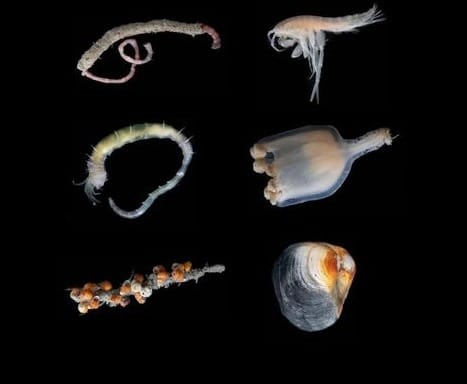
Some of the lifeforms found at Freya mounds: Image: UiT / Ocean Census / REV Ocean
Panieri and her colleagues decided to explore this region after previous detections of massive plumes of gassy bubbles rising up from the seafloor. One of these plumes measured two miles in height, making it the tallest plume of this kind ever found in the oceans. While the team expected to find geological activity, it was still a surprise to see this wealth of gas-stuffed mounds, leaking crude oil and methane, as well as the ecosystem of tubeworms, snails, crustaceans, and microbes that are fueled by chemicals from the seep.
In addition to discovering this biological hub at the Freya mounds, the team also explored ecosystems living on hydrothermal vents in the nearby seafloor in the Fram Strait. Hydrothermal vents form at fissures in the seafloor where hot mineral-rich water erupts into the ocean, and they are also known for supporting rich chemosynthetic ecosystems.
The expedition revealed that the organisms living in the hydrate seeps and the vent systems are related, suggesting an ecological connectivity in the Arctic that is absent in other parts of the ocean.
“The Fram Strait of the Arctic is a rare place where deep-sea vents and seeps occur close to each other,” said study co-author Jon Copley, a professor of ocean exploration and science communication at the University of Southampton, in an email to 404 Media.
“The deep Arctic is also a part of the world where there aren't as many deep-sea species overall as other regions, because deep-sea life is still recovering from when a thick ice sheet covered much of the ocean around 20,000 years ago,” he continued. “But hydrothermal vents and cold seeps are an important part of deep-sea biodiversity there today, because life carried on in those chemosynthetic oases beneath that ice-capped ocean.”

Freya gas hydrate mounds with different morphologies. Image: UiT / Ocean Census / REV Ocean
Gas hydrates also store huge volumes of greenhouse gases, like methane, which could potentially be released as ocean temperatures rise, making these environments a bit of a wild card for climate predictions. While the Freya mounds are too deep to be affected by ocean warming, its discovery helps to fill in the map of these oily, gas-rich sites in the ocean.
To that point, these seeps are also potential sites for resource extraction through offshore oil drilling and deep sea mining. A central goal of the Ocean Census Arctic Deep expedition is to explore these remote regions to document their ecological activity and assess their vulnerability to future industrial activities.
“Research has already established that hydrothermal vents must be protected from deep-sea mining anywhere in the world, because of the unique colonies of species that live around them,” Copley said. “Our study indicates that deep cold seeps in the Arctic will need similar protection, because they are part of the same web of life with hydrothermal vents in that region. And there are undoubtedly more deep methane hydrate seeps like the Freya Mounds out there in the Arctic, as other deep bubble plumes have been detected nearby.”
“So our discovery shows how much there still is to explore and understand about Arctic deep-sea life—and the need for caution and protection if the Norwegian government resumes plans for deep-sea mining there,” he added, noting that Norway’s parliament has put these plans temporarily on hold, but they could reverse that decision in the future.
This is why Panieri and her colleagues believe that it is critical to secure more funding and support for Arctic exploration, and ocean research more broadly. These expeditions not only reveal new and exotic organisms, they have also been inspired novel biomolecules used in medicines, among other applications.
“The sea floor and the ocean is almost unknown,” Panieri said. “There is so much to be investigated. I think this is also the take-home message here: Every time that we have the possibility to see the seafloor, we discover something new.”