
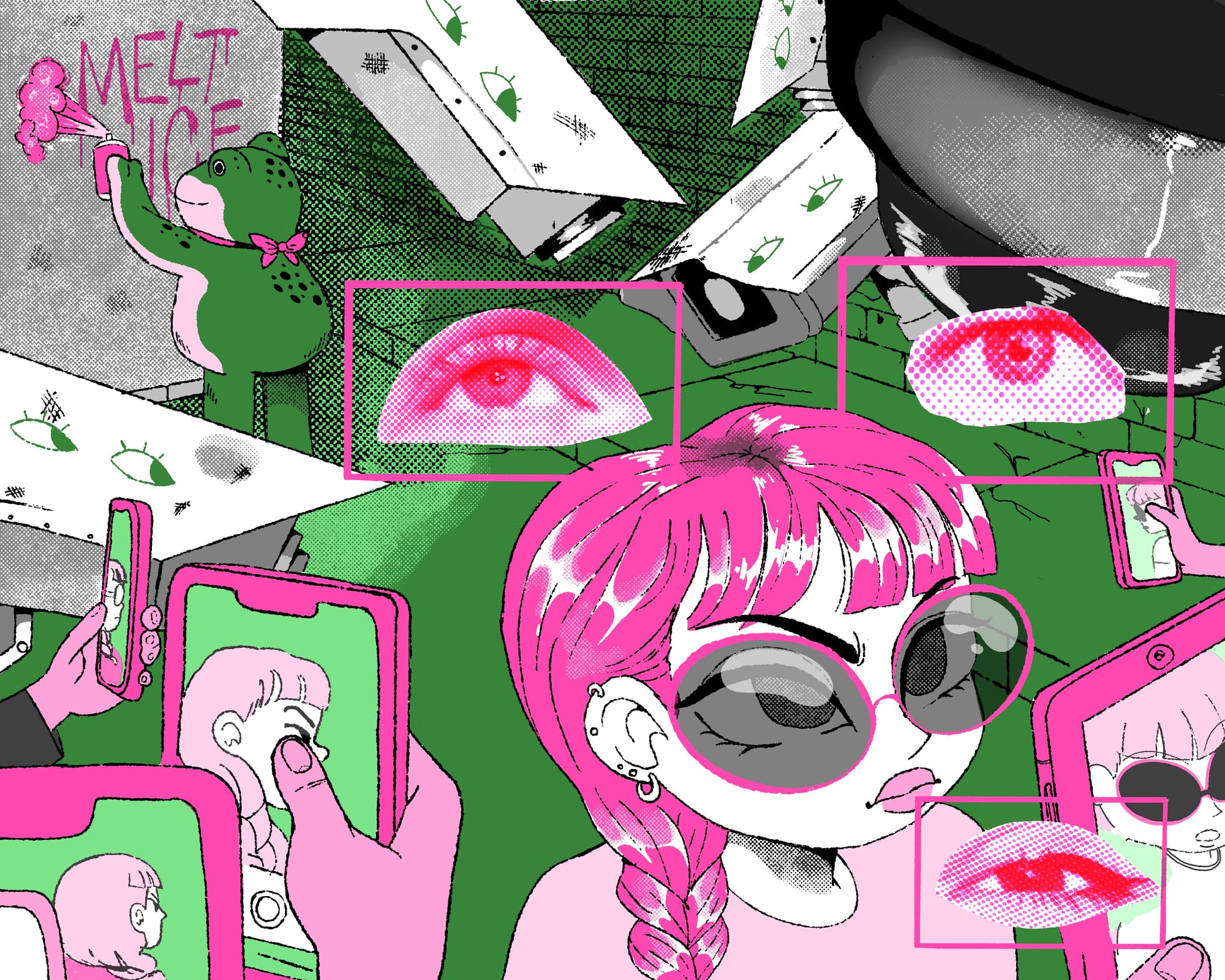
404 Media is making a print zine about the surveillance tactics used by ICE, and the ways people are resisting this technology. It will be 16 pages and printed on a risograph printer by a printshop in Los Angeles. It contains both reworked versions of our best reporting on ICE and some new articles for the zine. It will be available at the beginning of January.
I have been somewhat obsessed with making a print product for the last year or so, and we’re really excited to try this experiment. If it goes well, we hope to make more of our journalism available in print. We are doing this in part because we were invited to help throw a benefit concert by our friends at heaven2nite in Los Angeles on January 4, with the proceeds going to the Coalition for Humane Immigrant Rights (CHIRLA), an LA-based nonprofit providing support to Dreamers, immigrant families, and low-wage workers in California. We are going to be giving away copies of the zine at that concert and are selling copies on our Shopify page to ship in early January.
 404 Media
Why are we doing this? Well, zines are cool, and print media is cool. We have joked about wanting to print out our blogs and hand them out door-to-door or staple them to lamp posts. Handing out zines at a concert or sending them to you in the mail will get the job done, too.
We have spent the last two-and-a-half years trying to build something more sustainable and more human in a world and on an internet that feels more automated and more artificial than ever. We have shown that it’s possible for a small team of dedicated reporters to do impactful, groundbreaking accountability journalism on the companies and powers that are pushing us to a more inhumane world without overwhelmingly focusing on appeasing social media and search algorithms. Nevertheless, we still spend a lot of our time trying to figure out how to reach new audiences using social media and search, without making ourselves feel totally beholden to it. Alongside that, we put a huge amount of effort into convincing people who find our stuff on Instagram or TikTok or YouTube or Reddit (and Bluesky and Mastodon) to follow our work on platforms where we can directly reach them without an algorithmic intermediary. That’s why we focus so much on building our own website, our own direct email newsletters, our own full-text RSS feeds, and RSS-based podcast feeds.
This has gone well, but we have seen our colleagues at The Onion and other independent media outlets bring back the printed word, which, again, is cool, but also comes with other benefits. Print can totally sidestep Big Tech’s distribution mechanisms. It can be mailed, sold in stores, and handed out at concerts. It can be read and passed to a friend, donated to a thrift store and discovered by someone killing time on a weekend, or tossed in a recycling bin and rescued by a random passerby. It is a piece of physical media that can be organically discovered in the real world.
Print does come with some complications, most notably it is significantly more expensive to make and distribute a print product than it is to make a website, and it’s also a slower medium (duh). Ghost, our website and email infrastructure, also doesn’t have a native way to integrate a print subscription into a membership. This is a long way of saying that the only way this first print experiment makes sense is if we sell it as a separate product. Subscribers at the Supporter level will get a discount; we can’t yet include print in your existing subscription for all sorts of logistical and financial reasons, but we will eventually make a PDF of the zine available to subscribers. If you're a subscriber, your code is at the bottom of this post.
Some other details: Our cover art was made by Veri Alvarez, a super talented LA-based artist whose work you can find here. The interior of the magazine was designed and laid out by our old friend Ernie Smith, who runs the amazing Tedium newsletter and who was willing to unretire from his days of laying out newspapers to help us with this. We are printing it at Punch Kiss Press, a DIY risograph studio here in Los Angeles. For those unfamiliar, risograph printing is sort of like silkscreening on paper, where you print one color at a time and layer them on top of each other to get very cool color mixing effects.
We did not originally set out to spend most of the last year reporting on ICE. But we have watched the agency grow from an already horrifying organization into a deportation force that is better funded than most militaries. We have seen full-scale occupations of Los Angeles and Chicago, daily raids playing out in cities, towns, and workplaces across the country, and people getting abducted while they are at work, shopping, or walking down the street.
As this has played out, we have focused on highlighting the ways that the Trump administration has used the considerable power of the federal government and the vast amounts of information it has to empower ICE’s surveillance machine. Technologies and databases created during earlier administrations for one governmental purpose (collecting taxes, for example) have been repurposed as huge caches of data now used to track and detain undocumented immigrants. Privacy protections and data sharing walls between federal agencies have been knocked down. Technologies that were designed for local law enforcement or were created to make rich people feel safer, like license plate tracking cameras, have grown into huge surveillance dragnets that can be accessed by ICE. Surveillance tools that have always been concerning—phone hacking malware, social media surveillance software, facial recognition algorithms, and AI-powered smart glasses—are being used against some of society’s most vulnerable people. There is not a ton of reason for optimism, but in the face of an oppressive force, people are fighting back, and we tried to highlight their work in the zine, too.
Again, this is an experiment, so we can’t commit at the moment to a print subscription, future zines, future magazines, or anything like that. But we are hopeful that people like it and that we can figure out how to do more print products and to do them more often. If you have a connection at a newspaper printing press, a place that prints magazines or catalogs, or otherwise have expertise in printmaking, design, layout, or other things that deal with the printed word, please get in touch, it will help us as we explore the feasibility of doing future print products (jason@404media.co).
We are also hoping that groups who work with immigrants throughout the United States will be interested in this; if that’s you please email me (jason@404media.co). We are also exploring translating the zine into Spanish.
If you are a subscriber, your discount code is below this:
.
.
.
.
.