Almost a decade ago Jason and I sat in the roof garden in VICE’s Brooklyn office to talk to Whitney Phillips, a professor and expert on digital communications and ethics. The media, academics, and political pundits were still trying to wrap their minds around the fact that Donald Trump won his first presidential election, and Phillips was talking to us for a postmortem she was writing about how the media mostly failed in covering the new, far right, and extremely online politics that had taken over the culture in the years leading up to the 2016 election.
Politics in the United States and globally careening to the far right over the last 10 years is not a problem that can be blamed entirely on technology, the internet, or the media. It is a complicated, multifaceted, multi generational issue that spans economics, geopolitics, demographics, and more. But the problem, broadly speaking, which Phillips identified and named her research after, was the concept of “amplification.”
The idea, as laid out in her paper, The Oxygen of Amplification, is that many media outlets of all sizes and across the political spectrum, interviewed and covered people, most of them young white men, in the rising movement that at the time was often referred to as the “alt right.” The issue was that this coverage amplified their message even if it didn’t explicitly endorse it, and without framing their politics as inherently evil and detrimental to people and society.
Since Phillips’ report was published and often cited as one good explanation for how 4chan’s tiny political vanguard was able to seize such an outsized role in culture and politics, “amplification” has become a widely bandied about accusation. Initially this happened against media coverage that still “platformed” bad people, but eventually and erroneously, accusations of “amplification” got lobbed against pretty much any type of coverage someone didn’t like. For example, when we cover bad actors we often get criticized for amplifying them, even when that coverage leads to internet platforms enforcing their policies and those bad actors being banned.
But despite the concept of amplification being widely cited and adopted by the media and media knowers, it has been eight years since Phillips published her report, Trump is president again, and many Americans are too nihilistic or busy trying to prevent their neighbors from being deported to care that we are in the middle of an amplification renaissance.
There is no better example of this than the current obsession with Braden Peters, a so-called “looksmaxxer” who streams on Kick as Clavicular. I’ve known about the looksmaxxing community for years because it neighbors other online Superfund sites like 4chan and watering holes for self described involuntary celibates. Peters entered the mainstream media bloodstream by attaching himself to more famous racists and misogynists like Nick Fuentes and Andrew Tate, who livestreamed themselves hitting the club scene in Miami with Peters. This group in turn attached itself to the only racist who could rival Trump in terms of fame, Kanye West, when it sang along and Sieg Heiled to his Nazi anthem “Heil Hitler.”
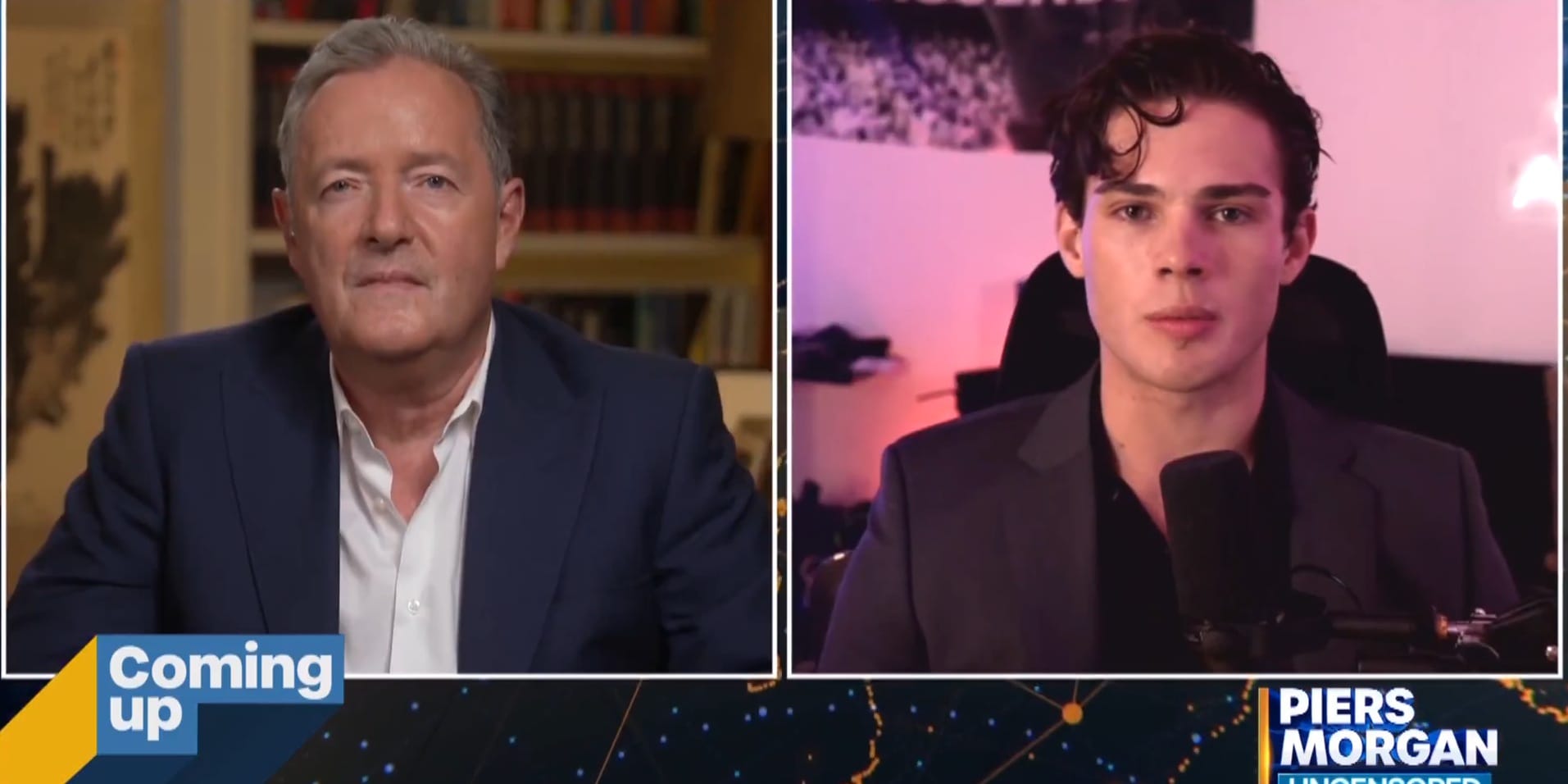
Who is this other, square jawed racist in the sprinter van next to these other, well established and by now boring racists? you might ask yourself if you saw one of the clips of this group Miami making the rounds online. The answer came from the New York Times, Piers Morgan, GQ, The Adam Friedland Show, and others.
When you get past the novelty of Clavicular’s fresh face and lingo, the answer is profoundly uninteresting. Clavicular floated to the surface of the cesspool which is the looksmaxxing community. Primarily, it’s a forum where a bunch of young men who can’t get laid riled themselves up and created a theory of the world which views romantic life as a zero sum game they are losing. Sex with women is a fungible commodity that is most easily accessed by achieving an arbitrary definition of physical attractiveness, which by extension makes life better and easier in every way imaginable. Jobs are easier to get, consequences can be avoided, and other men can be “mogged” into submission by sheer aesthetic superiority. These looksmaxxers will stop at nothing to improve their appearance, including hitting themselves in the face with a hammer to change the shape of their face, taking various steroids, and doing DIY surgery.
As Werner Herzog said when he intensely stared into the eyes of a chicken, when I view an interview with Peters, I am overwhelmed by the enormity and stupidity of his flat brain. In a recent interview for his podcast, Adam Friedland ironically needled Peters and got him to proudly admit that he only lasts a minute in bed; the moment was funny but also revealing of how pathetic Peters is.
But let me be clear because much of the coverage of Peters hasn’t been about this particular point: Peters is a bad person to wield any cultural capital because the lifestyle he’s promoting is deeply misogynistic, racist, and dangerous. Looksmaxxing is a strategy that emerged among “incels,” who themselves emerged out of the pick up artist (PUA) community. All of these philosophies are founded on a resentment of women, which they view as having easier lives because they think they have easier access to sex, and that they hate because they think women deny them that sex. Peters has claimed looksmaxxing transcends politics, but this foundational discrimination against women is inherently regressive and right wing, which is why Peters is being boosted by the likes of Nick Fuentes, who doesn’t believe women should have the right to vote. This philosophy is maybe somewhat normalized by a broader obsession in Silicon Valley and beyond to optimize the human body with supplements, peptides, and figures like Bryan Johnson who aims to live forever.
The good news is that these looksmaxxing people are freaks and losers. They are a tiny and insignificant group that has no power in numbers. The bad news is that the entire point of amplification is that it can give a tiny group of people incredible power by shaping culture. It is fine and fair to document the freak show, and it’s important to explain why it is bad, but even if we start by doing it ironically, adopting the vocabulary of “mogging,” “looksmaxxing,” “jestering,” “cortisol spikes,” etc, allows the small freak show to shape our world in its image. We’ve already lost such battles around terms like “sigma,” which emerged from the same misogynistic culture, and is now so acceptable even Dora the Explorer is saying it.
As Phillips wrote in her report on amplification:
“No matter the specific framing, stories should avoid deferring to manipulators’ chosen language, explanations, or justifications. Joel Stein’s TIME magazine interview with avowed neo-Nazi and serial online abuser Andrew Auernheimer, discussed in Part One of the report, provides one example. Not only did Stein frame his subject as a ‘troll’ throughout (thereby minimizing the embodied impact of Auernheimer’s targeted attacks), he explicitly described him as ‘probably the biggest troll in history,’ a tag line Auernheimer could have written himself.”
And as I told Phillips at the time:
“Beyond this specific example, employing manipulators’ framings has the effect [...] of allowing manipulators to set the narrative and linguistic agenda, carve the world up into categories of their choosing, and appear to wield much more influence than they actually do. They don’t have the numbers to steer the cultural conversation on their own, and they should not be given any assistance, inadvertent or otherwise, in these efforts.”