
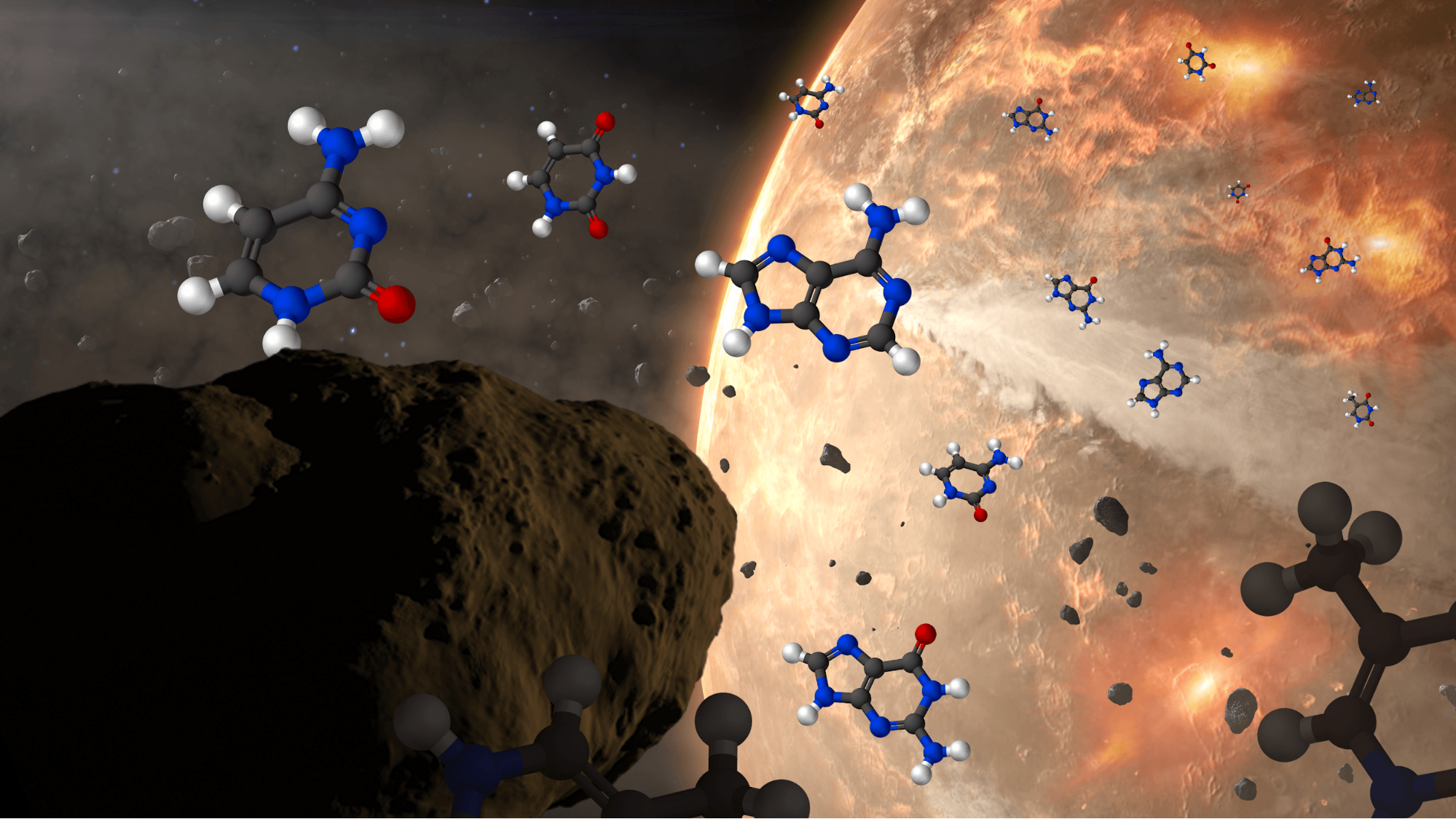
Scientists have discovered all five nucleobases—the fundamental components of DNA and RNA—in pristine samples from the asteroid Ryugu, according to a study published on Monday in Nature Astronomy. The finding strengthens the case that the ingredients for life are abundant in the solar system and may have found their way to Earth from space, according to a study published on Monday in Nature Astronomy.
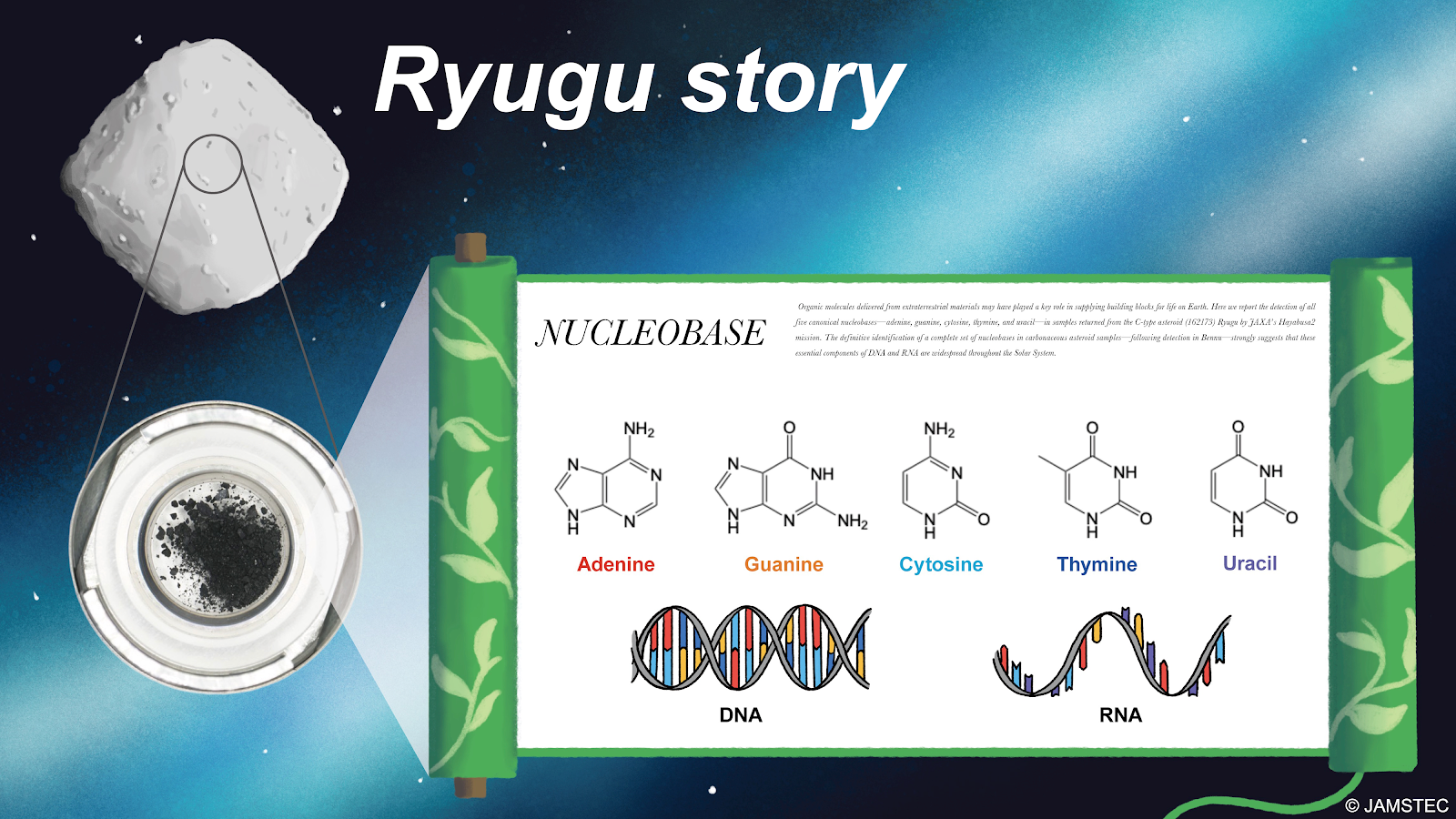
Life as we know it runs on DNA and RNA, which are built from five chemical bases: adenine, guanine, cytosine, thymine, and uracil. A team has now identified this “complete set” of nucleobases in rocks snatched from the surface of Ryugu in 2019 by the Japanese spacecraft Hayabusa-2, which successfully returned them to Earth the following year.
This discovery corroborates the results from another mission, NASA’s OSIRIS-REx, which returned samples of the asteroid Bennu that also contained all five nucleobases. Both asteroids belong to the same “carbonaceous” (C-type) family of primitive carbon-rich rocks, though the samples contain different ratios of the five nucleobases.
Taken together, the findings shed light on the origin of life on Earth and raise new questions about the odds that it exists elsewhere.
“These findings suggest that nucleobases may be widespread in carbonaceous asteroids and, by extension, in planetary systems,” said Toshiki Koga, a postdoctoral researcher at the Japan Agency for Marine-Earth Science and Technology (JAMSTEC), in an email to 404 Media.
“This means that some of the key molecular ingredients for life could be commonly available,” he added. “However, this does not imply that life itself is widespread, but rather that the chemical starting materials for life may be more common than previously thought.”
The emergence of life on Earth, also known as abiogenesis, remains one of the biggest mysteries in science. To untangle this enigma, scientists first need to figure out how our planet was initially enriched with the basic stuff of life—including water, amino acids, and the nucleobases that make up our genetic material.
One popular hypothesis suggests that asteroids bearing these biological building blocks pelted Earth as it formed more than four billion years ago. This idea has been supported by the presence of nucleobases in pieces of carbonaceous asteroids that have fallen down to Earth, such as the Murchison meteorite of Australia or the Orgueil meteorite of France.
Meteorites, however, are not pristine as they become eroded by exposure to space and can also be contaminated by terrestrial material after landing on Earth. To get cleaner samples, scientists launched several spacecraft to grab samples directly from the source, beginning with Japan’s Hayabusa mission, which delivered several milligrams of dusty grains from asteroid Itokawa to Earth in 2010.
Hayabusa-2 and OSIRIS-REx then obtained even larger samples from their targets, bringing back 5.4 grams from Ryugu and 121.6 grams from Bennu. Previous studies have already identified more than a dozen amino acids associated with life in both samples, as well as evidence that these asteroids were once altered by ice and water.
Now, following the discovery of all five nucleobases in the Bennu pebbles, Koga and his colleagues have found the complete set in Ryugu. The findings lend weight to the so-called “RNA world” model of abiogenesis. In this hypothesis, early life on Earth depended solely on RNA as a self-replicating molecule, laying the biological groundwork for later, more complicated systems that involved DNA and protein-based organisms. The extraterrestrial samples from Ryugu and Bennu provide evidence that at least some of the nucleobases that made up these early lifeforms came from outer space.
The results were “broadly in line with our expectations, but still very exciting to confirm,” Koga said. “All five nucleobases had already been detected in the Murchison meteorite and in samples from the asteroid Bennu. Since Ryugu is also a carbonaceous asteroid, we expected that these molecules might be present, and it was very satisfying to confirm that the complete set is indeed present in the Ryugu samples.”
But while both samples contained the royal flush of nucleobases, they differed in their relative abundances. For example, Bennu is much richer in pyrimidine nucleobases (cytosine, thymine and uracil) than Ryugu, though they both contain roughly similar levels of purine nucleobases (adenine and guanine). These idiosyncrasies point to a variety of formation processes that produced prebiotic materials on these celestial relics.
“Our results suggest that nucleobases can form under a range of conditions in early Solar System materials, particularly within primitive asteroid parent bodies that experienced aqueous alteration,” Koga said. “The observed relationship between nucleobase composition and ammonia abundance indicates that local chemical environments, such as the availability of ammonia, may play an important role.”
“At the same time, some precursor molecules may have formed earlier in interstellar environments, so nucleobase formation could involve multiple stages,” he continued. “Future studies, including analyses of different types of meteorites and laboratory experiments that simulate these conditions, will help to better constrain these formation pathways.”
In other words, understanding how these molecules form in space could help answer the age-old mystery of whether life is a rare cosmic fluke—or a common process in the universe. The research also highlights the remarkable ingenuity behind these sample-return missions, which have delivered tiny time capsules from the birth of our solar system directly into our hands.
“It is both exciting and humbling to work with these samples,” Koga said. “They are extremely limited and represent material that has remained largely unchanged since the early Solar System. At the same time, there is a strong sense of responsibility, because each tiny grain may contain important information about how organic molecules formed and evolved before the origin of life.”