
Georgia State University has rescinded a job offer given to a high profile activist who is currently fighting a case in which he allegedly wiped a security-focused Android phone before Customs and Border Protection (CBP) could search it. The case, which 404 Media first covered and has now received widespread and national attention, has important ramifications for privacy and when someone can still be charged with an offense even if authorities don’t have suspicion of any specific crime.
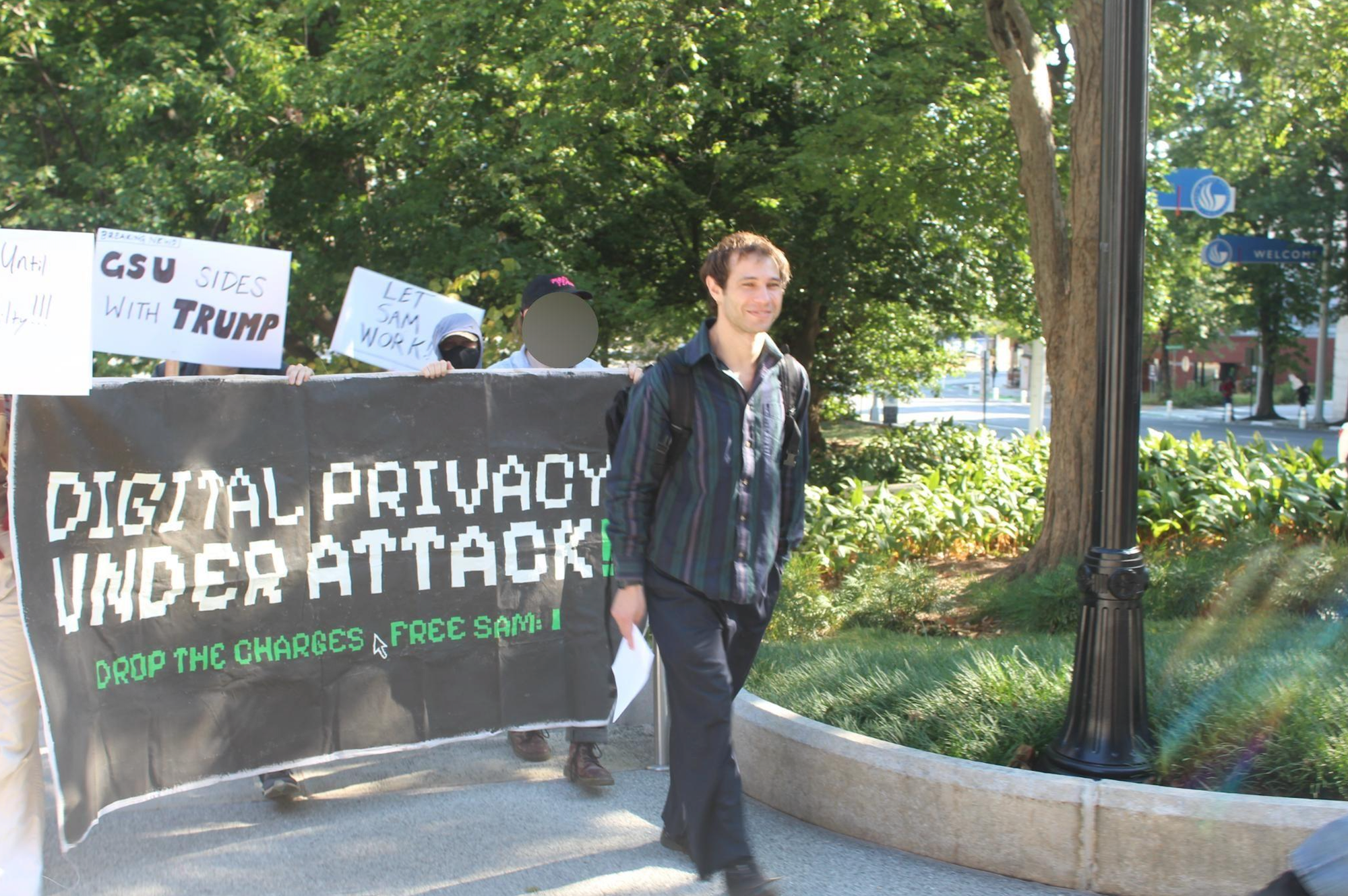
Earlier this month, activist Samuel Tunick and a group of supporters delivered a “demand letter” to the university. That letter, which Tunick shared with 404 Media, says he explained to the university he was facing a pending charge, which he describes as “an instance of textbook political repression, and a high profile civil liberties case.”
While delivering the letter, supporters held signs saying, “GSU sides with Trump,” and “Digital Privacy Under Attack!”
Tunick told 404 Media he was supposed to start his Teaching Assistant job on August 25. Then six hours before his first lab, Tunick received an automated email saying he had not passed the required background check. The letter says Tunick’s head of department asked the university for more information about the relevant hiring policy, “and she was told that there actually aren’t any.” Instead, in Tunick’s telling, “this was a subjective, and essentially arbitrary decision made for reasons that have not been made clear to me or other faculty.”
Tunick was also planning to pursue a M.S. of Geosciences at Georgia State, and was going to receive a tuition waiver and wages for his work as a Teaching Assistant. “Now I have had both my tuition waiver and source of income pulled out from under me at the drop of a hat, my economic security and academic career threatened due to a single absurd charge, to which I have pleaded ‘not guilty,’” the letter continues.
Tunick shared screenshots of emails between him and various faculty. One sent by the department head said, “I was told that the ‘Background Check Committee’ denied the approval for your hire, the Dean of Students denied the approval, and the legal department denied your approval.” That email reiterated there is no policy to be pointed to, and that each hire “undergoes a risk assessment on a case-by-case basis.” In another email, Tunick notes he had a misdemeanor in Fulton County, but these charges were dismissed.
Georgia State University did not respond to a request for comment.
404 Media first broke news of Tunick’s case in December and published an interview with Tunick and one of his lawyers, Matthew Dodge, in July. The airport encounter that led to the charge happened in January 2025, when Tunick was returning to the U.S. after a vacation in the Dominican Republic. Department of Homeland Security (DHS) officials called the airport ahead of time and asked agents there to stop Tunick, Dodge said.
The officers asked to search Tunick’s bags and pat him down, both of which he refused. Agents searched him and found nothing improper, Dodge said. Then, the agents said they wanted to search Tunick’s phone. Tunick provided them a code, which an officer then typed into the device. Rather than unlocking the phone, the device “went to a blank screen” and displayed the logo of GrapheneOS. In other words, the code wiped the device.
GrapheneOS is a security- and privacy-focused operating system, which includes all sorts of additional features. One of those is the duress password feature that “will irreversibly wipe the device,” according to GrapheneOS’s website.
Tunick participated in the Stop Cop City movement in Atlanta, and in a previous interview with 404 Media, Tunick put his prosecution for wiping his phone squarely in the context of other cases against the movement. Before the airport encounter, Tunick found out from his lawyer a tracker had been placed on his car. He also learned authorities subpoenaed his cellphone records and Gmail data. Tunick previously failed a background check for a job on a Christmas tree lot which involved going onto the property of a school, he previously said. When he asked the Atlanta Public Schools office about it, he was directed to the FBI.
The authorities “really just tried to dig up anything they could on me and they didn’t find anything,” Tunick previously told 404 Media. “At this point, it almost seems like it’s just intended to make my life miserable and discourage participation in any sort of advocacy or activism.”
The letter demands that Georgia State reinstate Tunick’s employment and/or the tuition waiver; provide more information about the hiring and background review process; and apply an “innocent until proven guilty” principle on hiring decisions.