
Advertisement
The Abstract

Scientists Discover the Earliest Human-Made Fire, Rewriting Evolutionary History

The discovery of fire-cracked handaxes and sparking tools in southern Britain pushes the timeline of controlled fires back 350,000 years.
Scientists Discover the Earliest Human-Made Fire, Rewriting Evolutionary History
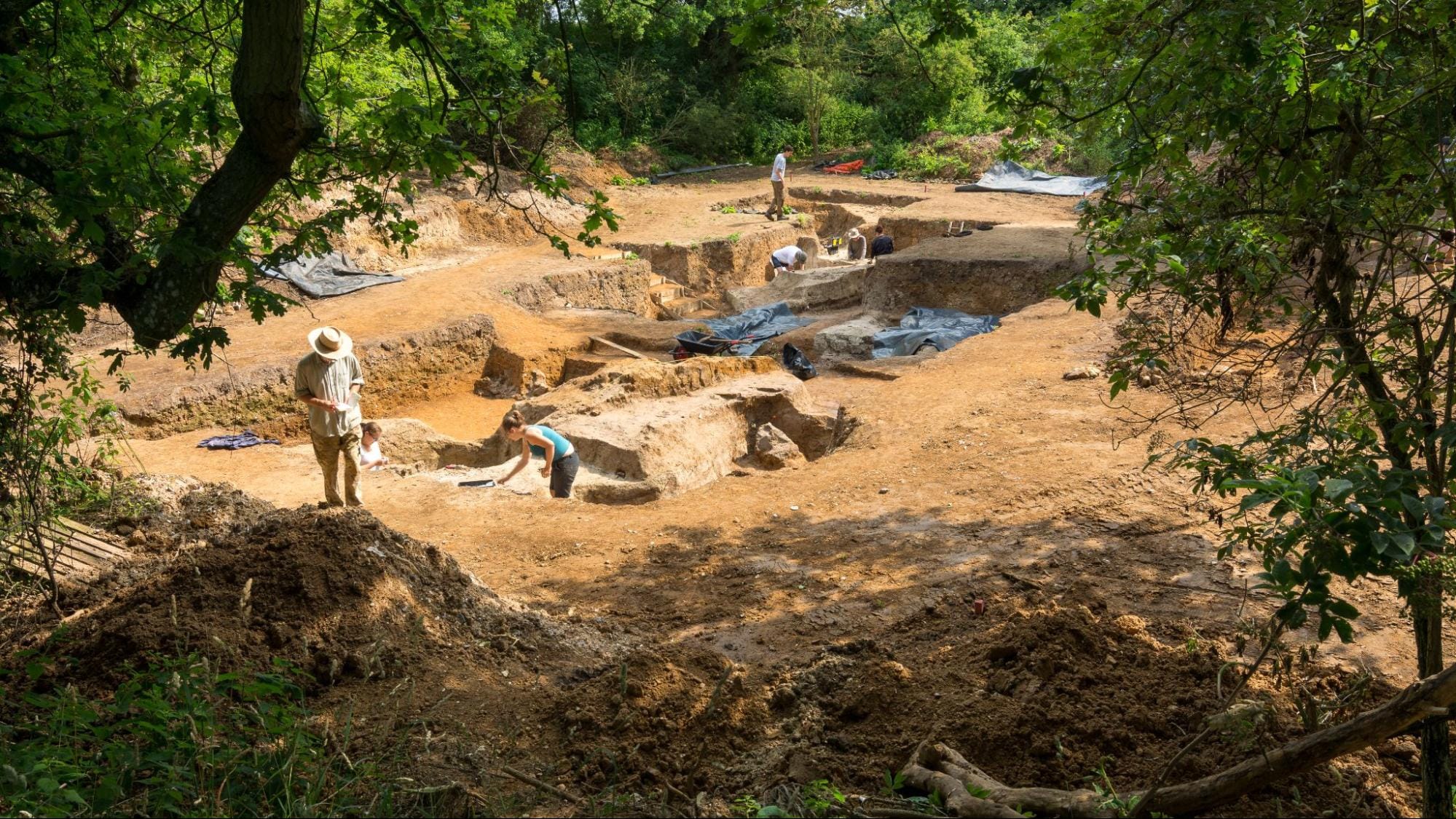
Excavation of 400,000 year old pond sediments at Barnham, Suffolk. Image: Jordan Mansfield, Pathways to Ancient Britain Project
🌘
Subscribe to 404 Media to get The Abstract, our newsletter about the most exciting and mind-boggling science news and studies of the week.

Humans made fires as early as 400,000 years ago, pushing the timeline of this crucial human innovation back a staggering 350,000 years, reports a study published on Wednesday in Nature

Mastery of fire is one of the most significant milestones in our evolutionary history, enabling early humans to cook nutritious food, seek protection from predators, and establish comfortable spaces for social gatherings. The ability to make fires is completely unique to the Homo genus that includes modern humans (Homo sapiens) and extinct humans, including Neanderthals.

Early humans may have opportunistically exploited wildfires more than one million years ago, but the oldest known controlled fires, which were intentionally lit with specialized tools, were previously dated back to about 50,000 years ago at Neanderthal sites in France. 

Now, archaeologists have unearthed the remains of campfires ignited by an unidentified group of humans 400,000 years ago at Barnham, a village near the southern coast of the United Kingdom.

“This is a 400,000-year-old site where we have the earliest evidence of making fire—not just in Britain or Europe, but in fact, anywhere else in the world,” said Nick Ashton, an archaeologist at the British Museum who co-authored the study, in a press briefing held on Tuesday.  

“Many of the great turning points in human development, and the development of our civilization, depended on fire,” added co-author Rob Davis, also an archaeologist at the British Museum. “We're a species who have used fire to really shape the world around us—in belief systems, as well. It's a very prominent part of belief systems across the world.” 

Artifacts have been recovered from Barnham for more than a century, but the remnants of this ancient hearth were identified within the past decade. The researchers were initially tipped off by the remains of heated clay sediments, hydrocarbons associated with fire, and fire-cracked flint handaxes. 

But the real smoking gun was the discovery of two small fragments of iron pyrite, a mineral commonly used to strike flint to produce sparks at later prehistoric campfires such as the French Neanderthal sites.

Discovery of the first fragment of iron pyrite in 2017 at Barnham, Suffolk Image: Jordan Mansfield, Pathways to Ancient Britain Project.

“Iron pyrite is a naturally occurring mineral, but through geological work in the area over the last 36 years, looking at 26 sites, we argue that pyrite is incredibly rare in the area,” said Ashton. “We think humans brought pyrite to the site with the intention of making fire.”

The fire-starters were probably Neanderthals, who were known to be present in the region at the time thanks to a skull found in Swanscombe, about 80 miles northeast of Barnham. But it’s possible that the fires were made by another human lineage such as Homo heidelbergensis, which also left bones in the U.K. around the same period. It was not Homo sapiens as our lineage emerged in Africa later, about 300,000 years ago. 

Regardless of this group’s identity, its ability to make fire would have been a major advantage, especially in the relatively cold environment of southern Britain at the time. It also hints that the ability to make fire extends far deeper into the past than previously known.

“We assume that the people who made the fire at Barnham brought the knowledge with them from continental Europe,” said co-author Chris Stringer, a physical anthropologist at the Natural History Museum. “There was a land bridge there. There had been a major cold stage about 450,000 years ago, which had probably wiped out everyone in Britain. Britain had to be repopulated all over again.” 

“Having that use of fire, which they must have brought with them when they came into Britain, would have helped them colonize this new area and move a bit further north to places where the winters are going to be colder,” he continued. “You can keep warm. You can keep wild animals away. You get more nutrition from your food.”

Excavation of the ancient campfire, removing diagonally opposed quadrants. The reddened sediment between band B’ is heated clay. Image: Jordan Mansfield, Pathways to Ancient Britain Project.

Although these humans likely had brains close in size to our own, the innovation of controlled fire would have amplified their cognitive development, social bonds, and symbolic capacities. In the flickering light of ancient campfires, these humans shared food, protection, and company, passing on a tradition that fundamentally reshaped our evolutionary trajectory.

“People were sitting around the fires, sharing information, having extra time beyond pure daylight to make things, to teach things, to communicate with each other, to tell stories,” Stringer said. “Maybe it may have even fueled the development of language.”

“We've got this crucial aspect in human evolution, and we can put a marker down that it was there 400,000 years ago,” he concluded.

Advertisement