
Welcome back to the Abstract! Here are the studies this week that gave birth to a one-ton baby, captured a legendary move on film, discovered a hole in space, and imagined our brains on Mars.
First, a sperm whale named Rounder gives birth on camera, complete with some surprise guests. Then: the deadliest headbutts on the high seas, a natural refuge from cosmic wrath, and rats take a trip to the space simulator.
As always, for more of my work, check out my book First Contact: The Story of Our Obsession with Aliens or subscribe to my personal newsletter the BeX Files.
Congratulations on your 2,000-pound baby
What a week it has been for the most majestic of all beats: sperm whale news. I’m going to have to go a little Ishmael on your asses, because two unrelated studies have peered into the underwater realm of these mysterious marine mammals and observed customs that have never been captured on film before.
First, researchers report the first detailed footage of a sperm whale birth, which scientists recorded in full with drones on the morning of July 8, 2023, off the coast of Dominica.
Though a handful of sperm whale births have been previously observed, this high-resolution aerial imagery is by far the most comprehensive footage. The team tracked the entire 34-minute delivery, followed by an extended postpartum period that revealed the members of the whale clan providing assistance to the calf and its mother, who is a well-studied female named Rounder (a.k.a whale #5714).
“Other adult females positioned themselves closely around [Rounder],” said researchers co-led by Alaa Maalouf, Joseph DelPreto, Maxime Lucas, and Simone Poetto of Project CETI, a collaboration that studies sperm whale behavior and communication. “Plumes of blood and the subsequent observation of the newborn marked the moment of delivery at 11:46 a.m.”
“The group rapidly transitioned to cohesive and highly active behavior; individuals took turns lifting the newborn, physically supporting and pushing it to the surface,” the team continued. “This phase continued for about an hour, during which time the entire unit remained tightly grouped. In addition, there were close passes by Fraser’s dolphins (Lagenodelphis hosei) and brief interactions with pilot whales (Globicephala macrorhynchus), which encompassed the sperm whale cluster and occasionally dove beneath them.”
It’s a sublime scene of new life, whale doulas, and curious bystanders in the delivery room. It also offers "unprecedented insights” into the complex sociality of sperm whales, a species that forms tight-knit matrilineal clans that share labor among members that span many generations, according to the study.
“These analyses provide evidence of birth attendance, or assistance, in a nonprimate species, a behavior long considered characteristic only of humans and their close relatives,” the team concluded.
Thar she blows, and headbutts!
In addition to that glimpse into the watery birthing bed, a separate team reports the first ever video footage of sperm whales headbutting each other.
“Here, we present 3 UAV (drone) based observations of head-butting and head-first contact between young sperm whales in the Azores and Balearic archipelagos,” said researchers led by Alec Burslem of the University of Hawaii at Manoa, who conducted the study in a previous role at the University of St. Andrews.
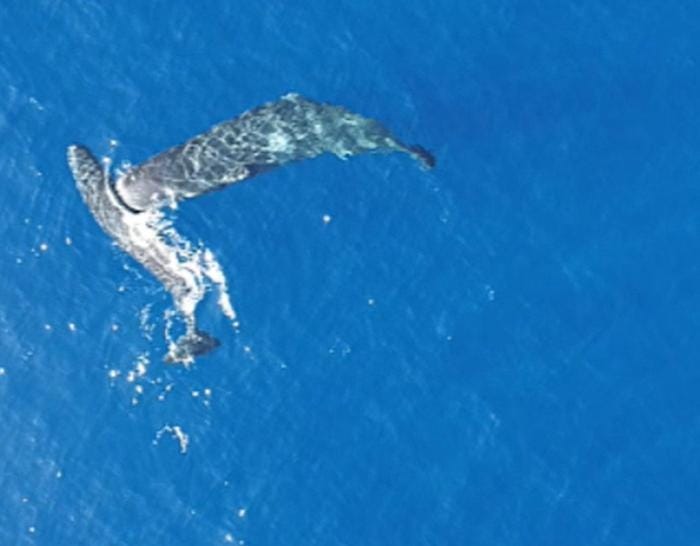
“To our knowledge, this behavior has not previously been positively confirmed in sperm whales with supporting documentation, or scientifically described,” the team said.
While this is the first time the headbutting has been captured on film, it has been anecdotally described by many sailors over the centuries. The study even opens with a quote from Owen Chase, a survivor of the whaling ship Essex, which was sunk by a sperm whale that rammed its head into the hull in 1820, providing the inspiration for Herman Melville’s Moby Dick. Over the course of months adrift on small whaleboats, most of the crew died and Chase was forced to resort to cannibalism of deceased crewmates to survive.
In short: The sperm whales give life, and the sperm whales taketh life away. This has been sperm whale news.
In non-sperm-whale news…
Mind the galactic cosmic ray gap
Scientists have discovered a giant cavity between Earth and the Moon that no dentist could ever hope to fill. You might be thinking—isn’t space already one big cavity? But while space is mostly sparse, it contains plenty of galactic cosmic rays (GCRs), energetic particles shot out by cosmic cataclysms like supernovas or gamma ray bursts.
Now, observations from China’s Chang’e-4, the first spacecraft ever to land on the far side of the Moon, has revealed a huge void where GCRs are warded off by Earth’s magnetic field. Given that these rays are hazardous to human health, the cavity could provide astronauts with some helpful cover from tiny cosmic bullets in future missions.
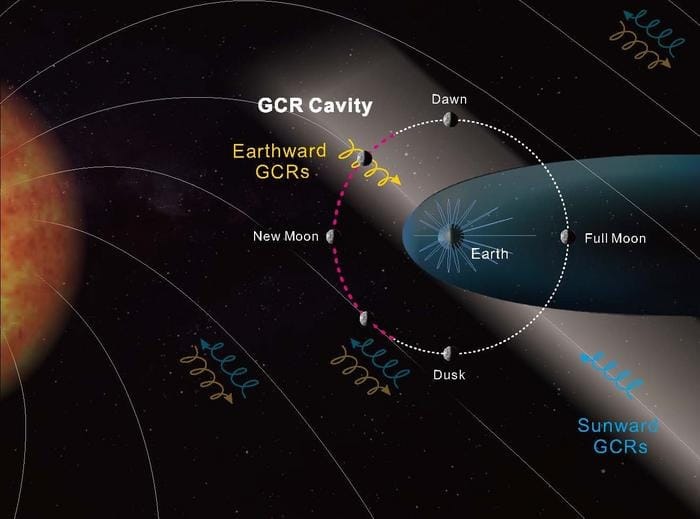
A figure depicting the GCR cavity. Image: Shang et al., Sci. Adv. 12, eadv1908
“GCRs were previously considered to be approximately uniformly distributed throughout the Earth-Moon space,” said researchers co-led by Wensai Shang of Shandong University at Weihai, Ji Liu of the University of Alberta, and Zigong Xu of Kiel University. The presence of the giant cavity “provides a potential strategy for mission planning…as operations could be timed to coincide with these lower radiation periods to reduce exposure risk.”
It’s not every day you unlock a giant new space shield! Sometimes, a cavity can be a good thing.
The brains of rats-tronauts
If humans do continue to explore space, we’ll need a lot more than a weird cavity to protect us. In a new study, scientists exposed rats to simulated space radiation in a lab and discovered that it had measurable impacts on the reward and risk circuits in their brains.
Rats exposed to radiation exhibited altered “cost–benefit decision-making…in both sexes” and “males displayed a global degradation of reward sensitivity...whereas females exhibited a selective shift toward high-risk, low-probability choices,” said researchers led by Richard Britten of Old Dominion University.
The findings add to a growing body of research on the many deleterious health effects of prolonged periods in space. As NASA prepares to launch Artemis 2 next month—the first mission to send humans to fly by the Moon since the Apollo era—it’s the perfect time to reflect on the realistic tradeoffs of our spacefaring dreams.
Assuming all goes to plan, the Artemis 2 crew will only be in space for 10 days, and will experience a negligible radiation dose. But a crewed trip to Mars would take at least a few years. To that end, the new study “advances understanding of how chronic low-dose space radiation may compromise behavioral regulation—a critical component of astronaut performance and mission safety.”
With that, here’s to happy travels and healthy brains—on Earth and off it.
Thanks for reading! See you next week.