Advertisement
News

Researchers Are Hunting America for Hidden Datacenters

The nonprofit research group Epoch AI is tracking the physical imprint of the technology that’s changing the world.
Researchers Are Hunting America for Hidden Datacenters
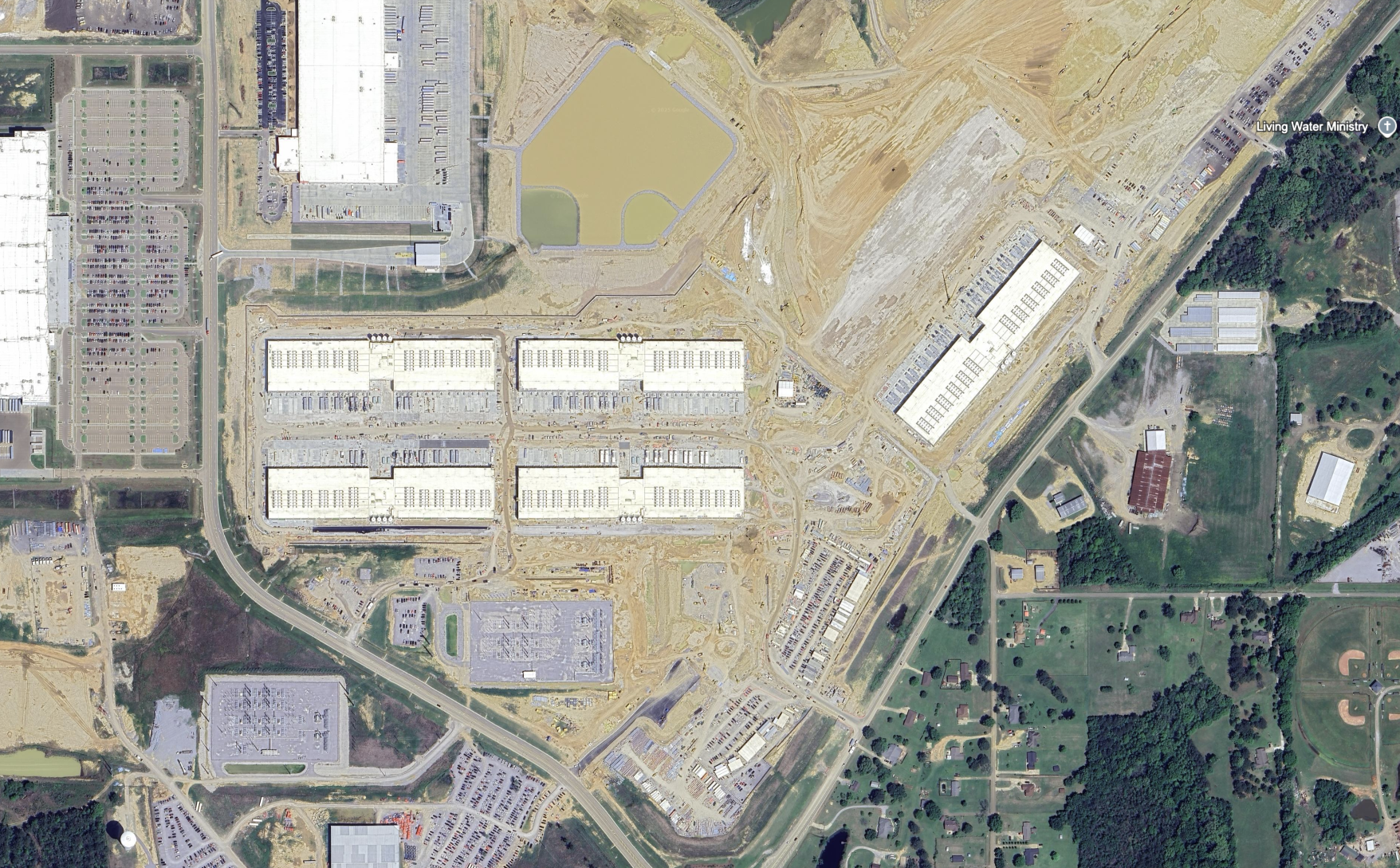
Google Earth image highlighted by Epoch AI.

A team of researchers at Epoch AI, a non-profit research institute, are using open-source intelligence to map the growth of America’s datacenters. The team pores over satellite imagery, building permits, and other local legal documents to build a map of the massive computer filled buildings springing up across the United States. They take that data and turn it into an interactive map that lists their costs, power output, and owners.

Massive datacenter construction projects are a growing and controversial industry in America. Silicon Valley and the Trump administration are betting the entire American economy on the continued growth of AI, a mission that’ll require spending billions of dollars on datacenters and new energy infrastructure. Epoch AI’s maps act as a central repository of information about the noisy and water hungry buildings growing in our communities.

On Epoch’s map there’s a green circle over New Albany, Ohio. Click the circle and it’ll take you to a satellite view of the business complex where Meta is constructing its "Prometheus" datacenter. According to Epoch, the total cost of construction for the datacenter so far is $18 billion and it uses 691 megawatts of power.

“A combination of weatherproof tents, colocation facilities and Meta’s traditional datacenter buildings, this datacenter shows Meta’s pivot towards AI,” Epoch said in the notes for the datacenter. “Reflecting that patchwork, our analysis uses a combination of land use maps, natural gas turbine permitting, and satellite/aerial imagery of cooling equipment to estimate compute capacity.” Users can even click through a timeline of the construction and watch the satellite imagery change as the datacenter grows.

“There’s a lot of public discourse and discourse with researchers about the future of AI,”  Jean-Stanislas Denain, a senior researcher at Epoch AI, told 404 Media. “Insiders have access to a lot of proprietary data, but many people do not. So it just seems very good for there to be this online resource.”

Zoom back out to a wider view of the country and click a circle in Memphis, Tennessee to learn about xAI’s Colossus 2. “To start powering the data center, xAI made the unusual choice to install natural gas turbines across the border in Mississippi, possibly to get faster approval for their operation,” Epoch AI noted. “Battery facility looks complete (though more might be added). Turbines look connected up, minimal construction around them. Based on this, and on earlier tweets from Elon Musk, 110,000 NVIDIA GB200 GPUs are operational.”

Information about the datacenters is incomplete. It’s impossible to know exactly how much everything costs and how it will run. State and local laws are variable so not all construction information is public and satellite imagery can only tell a person so much about what’s happening on the ground. Epoch AI’s map is likely only watching a fraction of the world’s datacenters. “As of November 2025, this subset is an estimated 15% of AI compute that has been delivered by chip manufacturers globally,” Epoch AI explained on its website. “We are expanding our search to find the largest data centers worldwide, using satellite imagery and other data sources.”

The methodology section of the site explains how Epoch AI does the work and includes timelapse photography of the monstrous datacenters growing. One of the big visual tells it looks for in satellite imagery is cooling equipment. “Modern AI data centers generate so much heat that the cooling equipment extends outside the buildings, usually around them or on the roof. Satellite imagery lets us identify the type of cooling, the number of cooling units, and (if applicable) the number of fans on each unit,” it said.

“We focus on cooling because it’s a very useful clue for figuring out the power consumption,” Denain said. “We first want to estimate power, but often we don’t have much information about that…and then we can relate power to the amount of compute and also the cost of building it. If you want to estimate power, cooling is pretty useful.”

After counting the fans, the Epoch team plugs the information into a model it’s designed that can help it figure out how much energy a datacenter uses. “This model is based on the type of cooling and physical features like the number of fans, the diameter of the fans, and how much floorspace the full cooling unit takes up,” Epoch AI explained on its website. “The cooling model still has significant uncertainty. Specification data suggests that the actual cooling capacity can be as much as 2× higher or lower than our model estimates, depending on the chosen fan speed.”

Charting America’s datacenters with open source intelligence isn’t a perfect practice. “In the discovery phase, some data centers will be so obscure that we won’t find news, rumors, or existing databases mentioning them. While larger data centers are more likely to be reported due to their significance and physical footprint, there are many smaller data centers (<100 MW) that could add up to significant levels of AI compute,” Epoch AI said.

But Epoch AI continues to expand its toolset and look through more satellite imagery with the goal of mapping Big Tech’s newest project. The goal is to cast light into the darkness. “Even if we have a perfect analysis of a data center, we may still be in the dark about who uses it, and how much they use,” Epoch AI’s website said. “AI companies like OpenAI and Anthropic make deals with hyperscalers such as Oracle and Amazon to rent compute, but the arrangement for any given data center is sometimes secret.”

Advertisement