
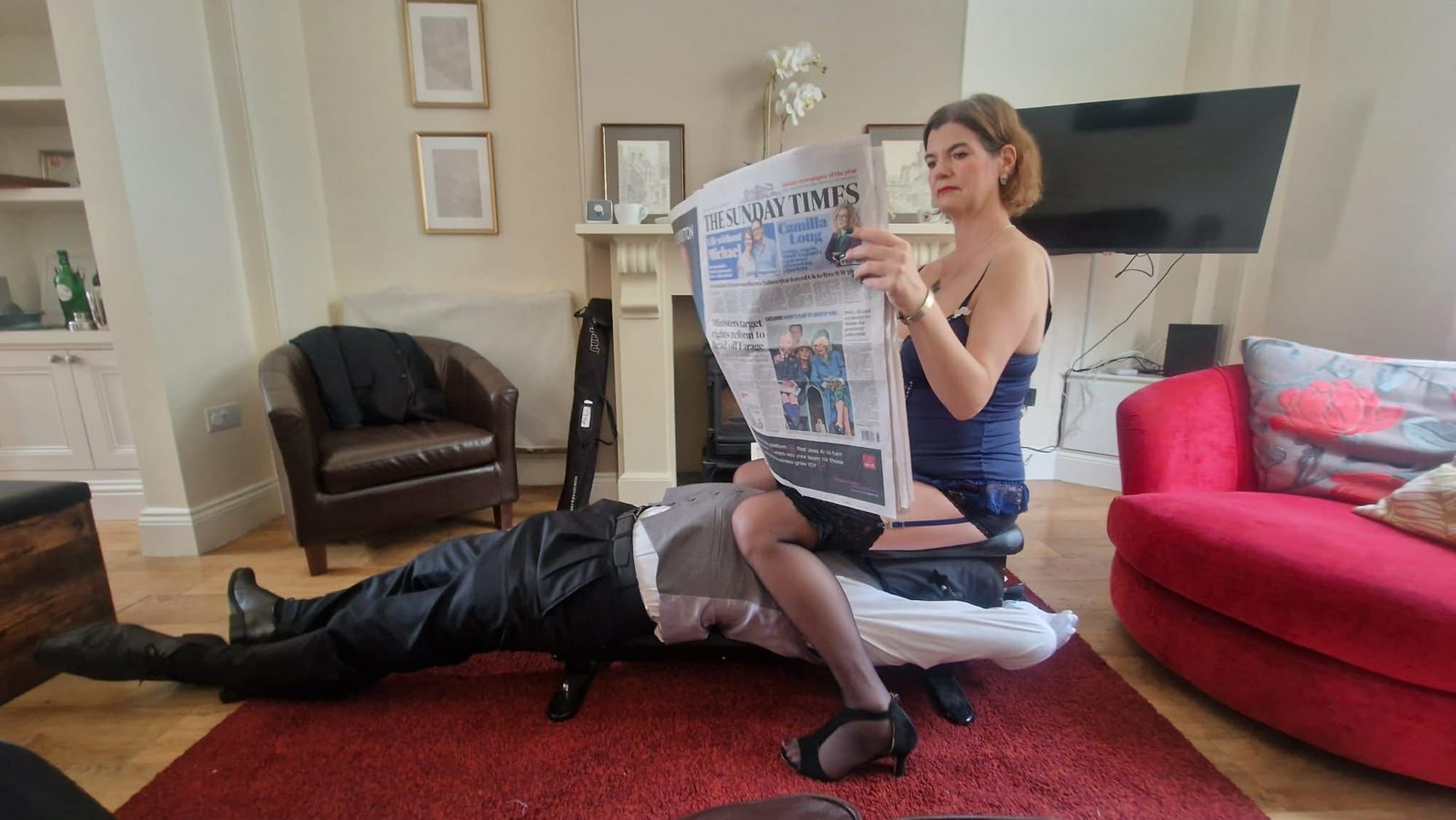
“I adore breath play. I love being strangled, suffocated and drowned, and I love strangling and suffocating others. Waterboarding: that’s my favourite,” Melissa Todd, a UK-based writer and sex worker, told me. “Many women do: it really isn’t only horrid men forcing us to do these dreadful depraved acts. Interrupting oxygen supply produces the most intense sensation of euphoria. I enjoy it in my private life, and I offer it in sessions too.”
Starting tomorrow, she and anyone else in the UK distributing or possessing this type of content, even if it’s just recorded in the privacy of their homes and not for sale on a porn site, could face up to five years in prison. The maximum penalty for possession is “two years’ imprisonment for pornography that depicts strangulation or suffocation, or penetrative sexual activity between certain relatives,” according to the law, and “three years’ imprisonment for pornography depicting sexual activity involving a person who is, or is pretending to be, under 16,” with five years as the maximum penalty for publication of all of the above.
Updates to the Crime and Policing Act go into force on November 6. The law criminalizes a list of sexual acts, including downloading or making choking and incest roleplay porn. According to the law, it will be a criminal offense in England and Wales to possess or publish porn that “explicitly and realistically” depicts strangulation or suffocation, penetrative sexual activity between people who “a reasonable person would think are related, or pretending to be related, in a certain way” and sexual activity between people where “a reasonable person would think at least one person is, or is pretending to be, under 16.” Sixteen is the age of consent in the UK.
“You have to speak up for porn you don’t like, as well as the porn you do, because otherwise the government will keep censoring more and more depictions of acts they don’t fancy."
“The offences only capture pornography that shows people which appear, to a reasonable person, to be real,” the law states — whatever that means.
The rest of the law is similarly vague in defining what’s criminalized. The “guidance” on the law says: “We consider that strangulation generally means one person applying pressure to another person’s neck,” and “We consider that suffocation will generally mean depriving a person of air in a way that affects their ability to breathe. Unlike strangulation, this does not require pressure to the neck. It could, for example, involve covering someone’s mouth and nose or compressing their chest.” This could mean anything from relatively common acts like face sitting or pushing someone’s face into a mattress, to gagging and more extreme breathplay generally left to professionals. The law says it’ll be left to the courts to decide.
As the adult industry advocacy group Free Speech Coalition notes in its guide for performers and platforms, the government has said this content doesn’t need to appear life-threatening to count.
“This isn’t just about my personal preferences,” Todd said. “You have to speak up for porn you don’t like, as well as the porn you do, because otherwise the government will keep censoring more and more depictions of acts they don’t fancy. Even if you think strangulation is disgusting, immoral, dangerous, that is no reason to ban it. In a liberal democracy people must be allowed to behave in ways you think ridiculous and disgusting, in the hope that they in turn will extend the same courtesy to you. I don’t understand why people go skiing, or camping, or abseiling, but I’m happy for them to crack on with it. Consenting adults must be allowed to do whatever they want with their own bodies. It is illiberal and dangerous for the government to interfere."
The effect of the law’s vagueness — as it has been in the US when legislators, payment processors and platforms similarly inflict poorly-defined terms on sex workers — is censorship and has a chilling effect on otherwise consensual legal activity between adults. It’s already happening: Adult clip site iWantClips warned, according to content creators using its platform, that in light of the law it’s banning a list of genres and acts: “iWantClips is required to remove certain categories of content from the platform for Artists located in the UK,” the message said, followed by a list including every kind of “smother” imaginable (including ass, foot, and breast smothering), plastic fetishes, all face sitting and specifically, face sitting in jeans, “butt drops,” and trampling fantasies. This isn’t the first time iWantClips has complied in advance of a threat to free speech: In October 2021, following new, strict moderation and documentation regulations set by Mastercard, the platform told creators they’d need to review their archives of content and make sure it was in compliance or risk a permanent ban.
Kinky sex has long drawn the ire of UK officials. In 2014, the British Board of Film Classification attempted to ban a litany of erotic acts from video on demand and streaming services under the The Audiovisual Media Services Regulation. Many protesters doing face-sit-ins in front of Parliament pointed out at the time that the ban was focused on acts that prioritize women’s pleasure. The ban was overturned in 2019.
UK based porn performer and producer Vex Ashley, who owns the independent studio Four Chambers, told me that when the Crime and Policing Bill went through Parliament earlier this year, she examined her back catalog and found that the work she considers her “magnum opus,” which explores the sexual archetype of the mother, could contain criminal content under this law.
“I had to go back and gut the film from the inside out,” Ashley told me. “It exists now in a very different form than it did when before. And obviously the law not only makes it illegal for me to publish it, but it also technically makes it illegal for me to possess the original cut of my film now, which just seems completely wild, considering that it’s me who is in it, and it's me talking about my own experience of my own sexuality.”
Ashley noted that attacks on sexual freedoms always come for non-normative sex first: “kink, fetish, queer and trans bodies, anything a compliance team can’t file under vanilla,” she said. This, she believes, is part of an ongoing swing toward conservatism, authoritarianism, and control.
"Even if you're somebody who doesn't care about porn, who doesn't care about sex, but you do care about this rollout of conservatism that's being force-fed to us, you can defend people's right to fuck and be fucked, and to explore that through media"
“The underlying message here is that actually, it's people's faults for being too horny, and that you should just control yourself,” she said. “That if you see this rollback in our sexual freedoms and this criminalisation of our sexual imaginations as wrong, you are just dangerous and perverted. Which is, I think, a swing back to old conservative and fascist ways of thinking about sex and freedom and bodily autonomy.” The “save the children” narratives that brought us harmful laws like FOSTA/SESTA in the US and an ongoing age verification nightmare around the world are at play with the Crime and Policing Act. In the UK, the Online Safety Act has forced people to verify their ages to use even non-sexually explicit parts of the internet. Looking at Pornhub from a UK-based IP address today, for example, you’d think it was a platform for podcasters and influencers; only once you log in and verify your age with a government ID and/or facial scan does the actual porn become visible.
Independent creators and people dependent on online sex work in the UK will be the hardest hit by this new law. Dominatrixes have reported that they’re expecting to take a financial hit. And even people and platforms outside of the UK may need to block users based in the UK from accessing their content to remain compliant. Many performers focus on specific niches to cater to audiences that seek out fetish content. But a lot of what’s being banned is already either banned by platforms or difficult to monetize, due to the extra-legal morality restrictions imposed by payment processors. Todd told me that while she enjoys the kind of content that’s now banned in the UK in her private life, she doesn’t bother uploading it to platforms where she could monetize it, because their terms of use have restricted most of it already.
Those trying to comply with the law and avoid the threat of jail time face a task. The law's guidance makes it clear that possession and publication apply retroactively. “It's easy to talk about pornography as though it's a constantly replenished stream of disposable content, but for many performers it represents years of work and a significant investment of time and money,” Todd said. “A back catalogue can be an important source of continuing income. If material has to be removed, that isn't simply a matter of changing what you film next week; it can mean losing an asset you've spent years creating.”
“Sex is a vital part of the human experience and it deserves exploration through storytelling, through media, through creation, in the same way that any other part of our experiences is,” Ashley said. “And that is not going to always be super comfortable. Sex is this very complicated, very vulnerable, very powerful thing, and it brings up a lot of things for different people.”
Deciding, as a society, that it’s not worth defending or thinking deeply about is doing us all a disservice, she said — and comes at the cost of sex workers’ safety and freedom. Faced with potential prison sentences for having a face sitting video stored on a hard drive, the freedom in this case is very literal. “Even if you're somebody who doesn't care about porn, who doesn't care about sex, but you do care about this rollout of conservatism that's being force-fed to us, you can defend people's right to fuck and be fucked, and to explore that through media... I think you can defend it even if you think it's complicated.”