
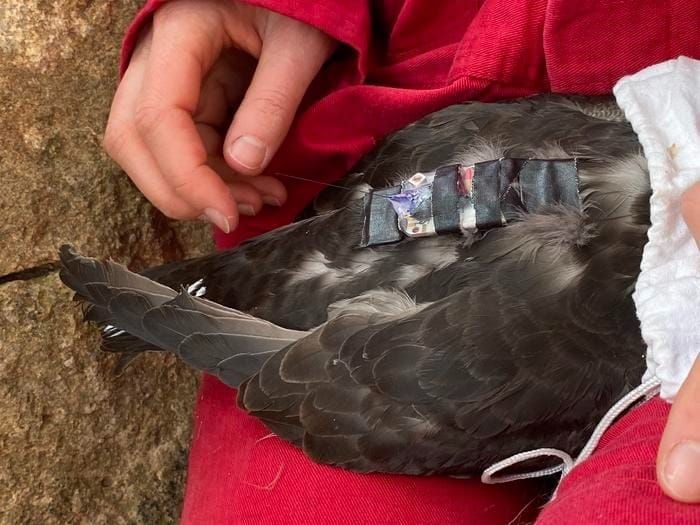
In what sounds like an avian riff on The Wire, scientists equipped seabirds with audio recorders in order to listen in on their interactions with fishing vessels across the world’s oceans, according to a study published on Wednesday in Science Advances.
The approach exposed a large number of so-called “unseen” vessels that did not have their location trackers switched on. Many vessels are required to continuously signal their location using the Automatic Identification System (AIS), which openly broadcasts a ship’s location, similar to flight tracking. But AIS can be disabled for legitimate reasons—such as evading pirates—or with more nefarious motivations, such as concealment of illegal fishing activities.
The new study was not designed to interrogate why any particular vessel switched off its AIS tracker. However, the discovery that seabirds are regularly interacting with unseen ships can shed light on broader efforts to monitor commercial fisheries, while also revealing new insights about seabird behavior, especially their risk of becoming “bycatch” when they are fatally trapped in fishing gear.
Unseen vessel activity “is concerning, or at least important, regardless of whether it's legal or illegal,” said Jonathan Rutter, a postdoctoral research fellow at the University of Oxford who led the study, in a call with 404 Media. He added that the recordings were not intended to be used for law-enforcement or surveillance, but that this line of research could become a “powerful tool for improving risk assessment” by recording seabird-vessel interactions that would otherwise be off the map.
Scientists have previously attached audio recorders to birds, such as penguins, to better understand their vocalizations and behavior, and teams have also probed seabird-vessel interactions with bird-borne radar.
Rutter and his colleagues were inspired to combine these approaches by attaching audio recorders to three seabird species—the northern gannet, Balearic shearwater, and Westland petrel—which all frequently interact with fishing vessels. The team tracked the movements of the birds with GPS, and then analyzed whether the audio overlapped with AIS data at the same time and location during recorded interactions.
The recordings showed that about 32 percent of the audio captured by seven gannets in the North Atlantic were from ships with their trackers off, while 12 percent of the audio captured by four shearwaters in the Mediterranean Sea were from unseen vessels. The one petrel in the study interacted with vessels in the South Pacific, but its geolocation device was damaged, so it was not possible to calculate how many ships it encountered had their trackers off.
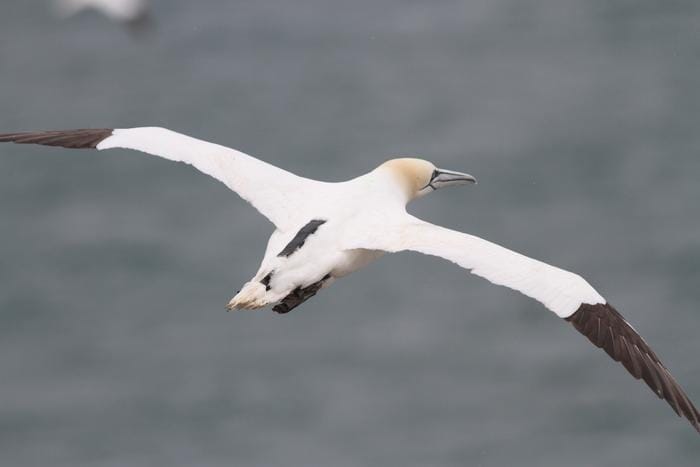
Rutter noted that the shearwaters were likely often interacting with smaller Mediterranean fishing boats that are not legally required to keep trackers on. However, the gannets encountered larger commercial vessels that are obligated to keep trackers active. While the researchers made a very conservative estimate that these birds visited unseen vessels for about one-third of the total duration of their daily encounters (or, about 22 minutes out of 68 minutes), it may well exceed half of that time.
“The fact that we found at least one third, and probably more than one half, of the audio detections being unseen was pretty surprising,” Rutter said. “This is not the same thing as saying that half of vessels are unseen; it's half of the time that gannets go to vessels, those vessels are unseen.”
“There are multiple reasons this could be,” he continued. “It could be illegal disabling, but at the same time, it could be poor satellite reception. There are lots of reasons that AIS can be off, and we want to emphasize that illegal fishing is a possibility, but that is not actually what we're showing. It's showing that there's a lot we're not seeing.”
Seabirds are attracted to fishing vessels to feed on discarded catch, but many perish during these encounters after becoming tangled in lines or caught on baited hooks. Rutter and his colleagues hope that their study could help to prevent these deadly incidents, while also providing a new tool for monitoring unseen vessel activity.
While this approach could enable real-time vessel detection, the team urged “caution in the use of animals as a fisheries surveillance tool, lest fishers come to mistrust scientists and/or marine animals themselves,” according to the study.
Though environmental and commercial interests are often at odds, there is plenty of collaboration between fisheries and conservation scientists with the goal of sustainable and healthy long-term fish stock. Fisheries that adhere to regulations also have an interest in working with researchers to combat illegal activity by competitors.
In addition, these audio recordings offer a new way to eavesdrop on wild seabird behavior. For example, the petrel’s recordings captured distinct landing and takeoff sequences previously observed in albatrosses, opening a new avenue of research into the flight patterns of this species. The recordings also highlight how human activity has upended food webs, as seabirds have become dependent on fishing vessel waste as a major source of food.
“One of the advantages of this is that we can understand in a more unbiased way how much [seabirds] actually interact with vessels—every day, multiple times a day for all the species we looked at actually, which is crazy if you think about it,” Rutter said.
“They're going out every day and just visiting boats all the time, and that shows the impact that we have on them as humans is really changing their feeding ecology,” he concluded.