
Welcome back to the Abstract! Here are the studies this week that spotted a blast from the past, opened a portal between realms, yakked it up, and rose from the ashes.
First, scientists have spotted a mysterious radio signal from the primordial universe that could illuminate cosmic evolution (it’s not aliens… sorry). Then: a diamond in the quantum rough, the decline of a fine bovine line, and a second-generation planet.
As always, for more of my work, check out my book First Contact: The Story of Our Obsession with Aliens, or subscribe to my personal newsletter The BeX Files.
A long time ago in a galaxy far, far away
Scientists have discovered the most distant fast radio burst (FRB), a type of mysterious radio flare from space. This burst erupted when the universe was only three billion years old and sent radio waves across 10 billion light years before they reached Earth on March 4, 2024.
The distant signal, known as FRB 20240304B, hails from an ancient galaxy beyond “redshift 2,” which means it originated more than twice as far as the next-farthest known FRB. Redshift, represented by the variable “z,” measures how wavelengths of light get stretched out in their journeys across space, a phenomenon that shifts them to the red end of the spectrum. Generally speaking, the more distant the object from Earth, the higher the redshift.
“Approximately one hundred FRBs have identified host galaxies with measured redshifts, with the vast majority at redshifts z ≲ 0.5,” said researchers led by Manisha Caleb of the Sydney Institute for Astronomy. “Only a small number of FRB host galaxies have been identified at z ≳ 1. This observational bias is driven by the sensitivity limit of radio observations that are capable of detecting FRBs and localizing their coordinates.”
Caleb and her colleagues were able to capture the remote flash using South Africa’s MeerKAT radio telescope. Follow-up observations with the James Webb Space Telescope pinpointed “a low-mass, clumpy, starforming galaxy” at redshift 2.148 as the host of the burst.
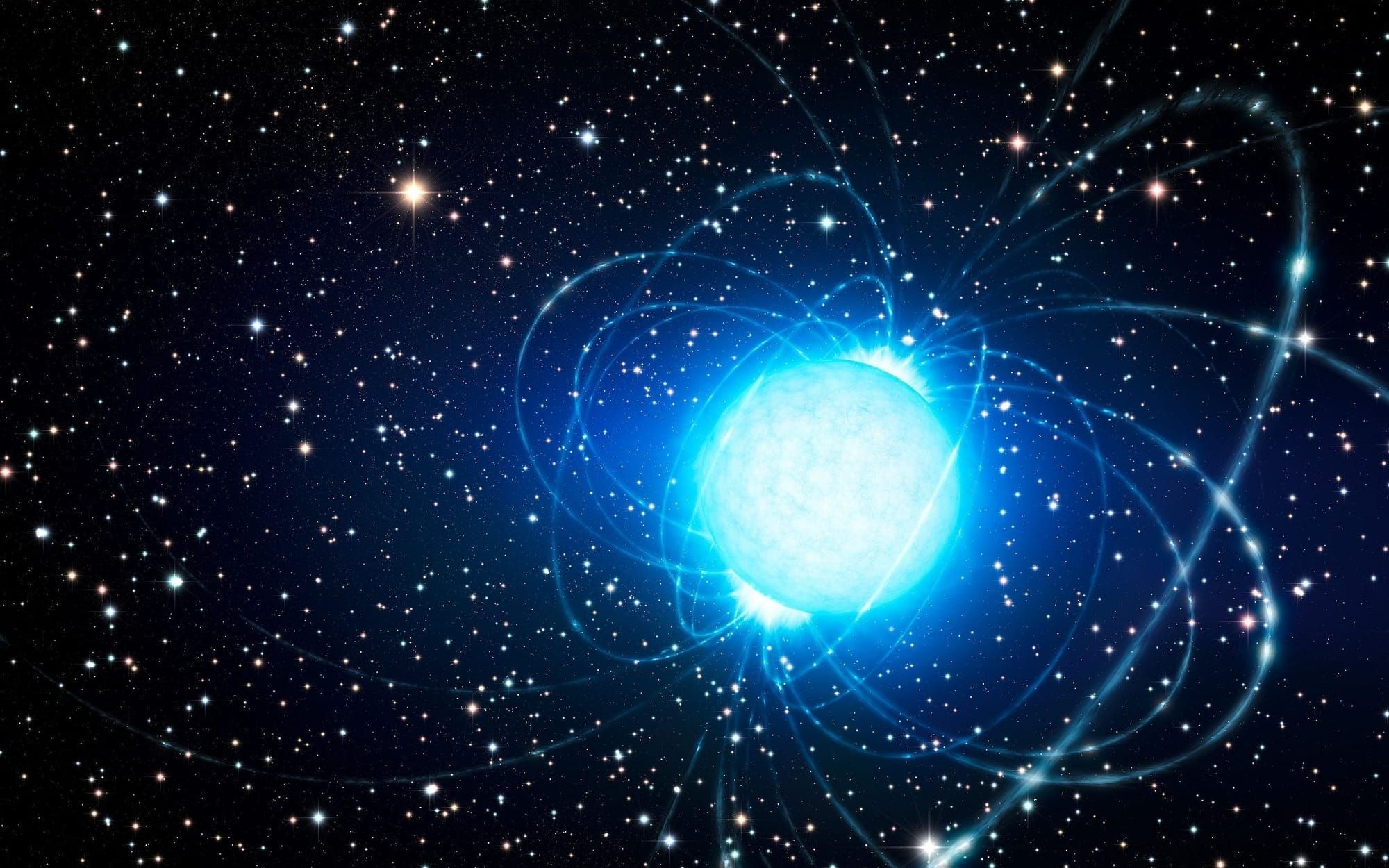
FRBs produce incredibly energetic radio pulses, but the exact mechanisms that generate them remain unknown. Given the diverse features of these bursts—for instance, some repeat, and some are one-offs—they might come from many different sources. In the case of FRB 20240304B, the team speculated that the burst is a magnetar, the highly magnetized remains of a massive star that went supernova.
“The low stellar mass, active star formation, and low metallicity of the host galaxy are consistent with a magnetar origin of the FRB,” the researchers concluded.
This milestone detection of such a distant and ancient FRB opens up the possibility of finding more bursts at high redshifts. In addition to pushing the limits of observation, future discoveries could allow scientists to extract clues about the evolution of the universe that become imprinted in these signals during their vast journeys. So bring on the bygone bursts!
In other news...
Putting a quantum spin on things
Time to shrink down from the largest cosmic scale to the tiny quantum realm. In a new study, scientists report that they successfully moved a centimeter-scale diamond with a force known as quantum spin, making it by far the largest object ever manipulated by a quantum effect. It represents a major breakthrough, as the diamond is the first object large enough to be subject to gravity to be moved in this way, further bridging the gap between the loopy quantum realm and regular, everyday physics.
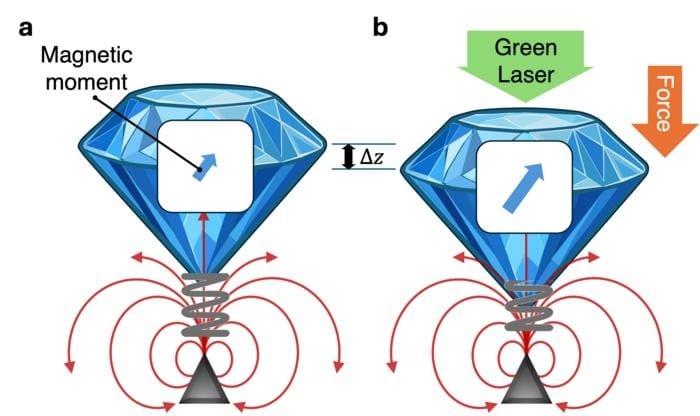
A graphical representation of the observed movements. a) When the laser is off, the diamond slab has a small magnetic moment (blue arrow) induced by the latent spin-state inside the nitrogen-vacancy centers of the diamond. b) When the green laser is on, the spin-state is polarized, causing the magnetic moment to fluctuate weakly, pushing the diamond down towards the magnetic field (red arrows). Image: Nayak et al., 2026
In the new work, scientists worked with a nitrogen-vacancy (NV) diamond containing electrons with “spin,” a form of angular momentum on the quantum scale. Then, they shot a laser at the diamond—as science often demands—which stimulated electrons to spin in a certain state that eerily moved the diamond.
“Experimentally observing this spin force for anything larger than atomic scales has proved challenging,” said researchers led by Anshuman Nayak of the Okinawa Institute of Science and Technology. “We have demonstrated the motional driving of a massive diamagnetically levitated mechanical oscillator by the force of NV spins in a gradient magnetic field.”
Congratulations, humanity: We just earned our license to quantum-motionally drive. Proceed responsibly.
New yak just dropped
Domestic cows are overwhelmingly the most common bovine species on Earth today, but this family of swole ungulates once contained a diversity of wild lineages that included aurochs, steppe bison, and oxen.
Now, scientists have discovered the remains of a distinct bovine species—named “yak X”—in Siberia’s Denisova Cave, which was also inhabited by many human species (hominins) during the Pleistocene era, which ended 12,000 years ago.
Yak X (cool name!) began diverging from extant yaks about 400,000 years ago, and had formed its own unique yak pack by 250,000 years ago, reports a team that sequenced its ancient genomes. The youngest bones from this mysterious animal date back about 27,200 years, so it must have died out sometime after.
“Yak X is a Pleistocene megafaunal species previously unknown to genomics,” said researchers co-led by Jonas Oppenheimer and Alexandre Gillardet of Stockholm University. “Yak X appears to have become genetically isolated from other bovines including bison and aurochs despite their apparent geographic proximity in Pleistocene mid-latitude Asia. This lack of gene flow is in notable contrast to hominins at Denisova Cave, which displayed complex patterns of admixture among multiple divergent lineages.”
In other words, hominins at this cave, including Neanderthals and Denisovans, appear to have interbred, while this yak didn’t cross with its fellow bovine relatives. This has been Yak News.
The birth and death of a phoenix planet
Planets are frequently obliterated by the explosive deaths of their stars, but they can also be born out of those same stellar ashes. Scientists have now directly observed the first evidence of one of these so-called “second-generation” planets that formed around a type of dead star called a white dwarf.
Located about 270 light years from Earth, the white dwarf—known as HS 0209+0832—was once a star similar to the Sun. About five million years ago, it shed its red giant shell and collapsed into its current husk state.
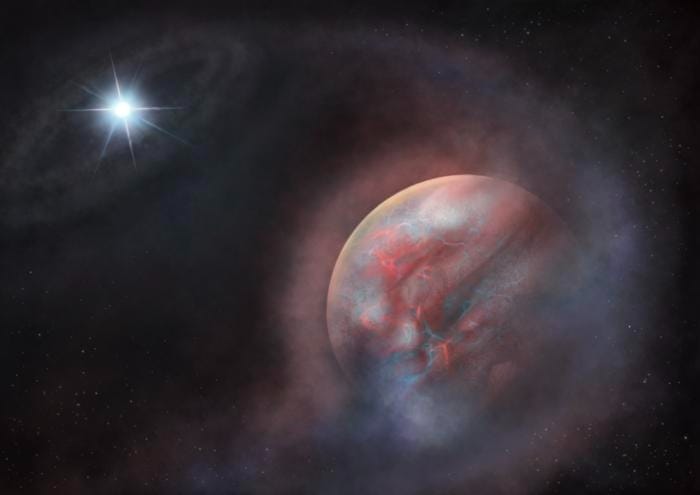
Since its transition to the afterlife, a new planet has coalesced out those ejected embers, though this world is destined for an early grave. Scientists spotted telltale signs of second-generation elements—including zinc, copper, and niobium—in the spectrum of the white dwarf, which are distinct from first-generation planetary ingredients, such as the silicon and iron that make up Earth. The discovery exposes a dead star feeding on its posthumous offspring that was birthed from its own ghostly gas.
“Here we report the discovery of a white dwarf accreting material that is unlike any Solar System object,” said researchers led by Jamie Williams of the University of Warwick. “The discovery of this second-generation planet that is chemically distinct from first-generation material demonstrates that close-in planets around white dwarfs can form…Establishing a sizable sample of such systems will open a window on second-generation planet formation.”
Some stars are so prolific that even death won’t stop them from making new worlds—and then eating them. Respect.
Thanks for reading! See you next week.