
Andy Yen, the CEO of Proton, had a message for an employee in the company’s security Slack channel who urged the company to at least take a few days to pentest newly written code before pushing it live. “That’s bullshit and loser thinking. Of course it’s possible to be fast and secure,” Yen wrote in the channel at the end of August. “Stop thinking always of how to be slower, and focus more on how to be faster.”
In a follow-up message, Yen reiterated his point: “only losers think like that.” His ultimate message for the team was to “stop lovingly handcrafting all our code and use AI more.”
That exchange was just one of many that showed how Yen and other company executives are aggressively pushing Proton towards AI. Proton is a Swiss company that famously makes the encrypted email service Proton Mail and a suite of privacy and security-focused products, including an encrypted drive service, an authenticator app, a password manager, and more.
In the last few months, Yen set up an email address for employees to contact if they come across anything blocking adoption of AI at Proton, so leadership can “ruthlessly smash everything that stands in the way of AI velocity;” Proton installed software on workers’ computers that track how much AI code the company is generating; and Yen said this is the last year that Proton will hire engineers at all, and instead only hire people to build things with AI.
That AI push came to head this week when 404 Media reported Proton said it would re-interview staff about their use of AI, with the clear implication that those interviews, and employees’ willingness to embrace AI, could decide whether a worker is fired or not.
404 Media spoke to eight current and one former Proton employees and reviewed Slack chats, meeting recordings, and an AI manifesto written by the company’s CTO. Our reporting reveals a culture of fear inside Proton, where many employees are hesitant to even mildly critique Yen’s views or discuss engineering problems. Workers describe an environment where employees have genuine concerns about security or being asked to develop security products with AI, but feel unable to voice them, lest Yen berates them in front of everyone or threatens their employment at the company.
“The CEO is in full AI psychosis and has been for a while now,” one of the sources told 404 Media.
Our reporting also paints a picture of Proton that is likely very different to the public’s perception of a company with a goal of carefully protecting privacy: one that in reality is barreling ahead with AI as quickly as possible so it can achieve the explicit goal of more annual revenue.
“Due to insufficient velocity,” Proton is not on track to achieve its annual recurring revenue target by the end of the year, one internal document obtained by 404 Media reads. Proton’s year-over-year growth is also “far away from what the market today considers to be good,” and, “By all metrics that matter, we’re an underperforming company.”
In response to detailed questions from 404 Media, a Proton spokesperson did not dispute any of our reporting or characterization of what’s happening inside of the company.
“It’s clear that some people at Proton are unhappy with our direction, or misunderstand it, and many people are anxious,” they said. “In our determination to move fast, we have sometimes been too blunt or too slow in explaining ourselves to our people. We will work on that, as their questions are the ones we most need to answer.”
Yen, a former CERN particle physicist, projects a measured approach in public, but internally he acts more like what one employee described as a “petulant child.” In May, Proton announced it was implementing post-quantum cryptography which should protect against future attacks from quantum computers. The work took years of effort, with one caveat that it would not work on older emails, only those written after the feature’s launch, at least for the moment. Yen was not happy that Proton was drawing attention to this limitation.
In a Slack channel dedicated to thanking people for their work, Yen jumped in. “Get it fixed,” he wrote, referring to Proton’s Reddit post announcing the feature. “Now Reddit is pissed and we look worse than Tuta,” he added, referring to a Proton competitor. When employees explained to Yen the nuances of the encryption and why that was not immediately possible, Yen wrote, “I find this whole thing stupid. You cannot announce this in this way.”
“Now we are left with two shitty choices. Deprioritize more important tasks for the business to re-encrypt old emails, or constantly get attacked online for not doing it. So maybe you can enlighten me on which of the two shitty choices we will take,” he wrote. “In the future there are two options. Either you guys are confident enough to not fuck this up, or you get my advice to make sure it is not fucked up,” he added. He then told a member of the team that made it to “go on Reddit.”
“So go on there with your personal account and comment to set the record straight,” he wrote. “Perception is more important than truth, the truth doesn’t matter if you don’t win on perception.”
One employee told 404 Media, “Whatever persona Andy [Yen] has out of Proton, he’s a straight up bully inside. He routinely breaks his little facade in Slack and calls people losers and stupid, often for stuff he’s paying them for.”
Ever since launching Proton Mail in 2014 after the Snowden revelations, Proton has steadily introduced new products that make Proton more of a worksuite than a simple email provider. More recently, those products were focused around AI, with the launch of Lumo, a large language model (LLM) chatbot that the company says doesn’t log conversations or train on user data. In June, Proton launched a 2.0 version of its chatbot.
Up until this point, Yen’s public comments on AI were relatively tame. In an August interview with WIRED, he said Proton is “building AI features and AI tools, because I think if the privacy companies do not find a way to step in to build privacy-first AI, we are essentially ceding the future to tech companies that don’t have the best interests of users at heart,” and that the company was “capitalizing” on the backlash to corporatized, invasive AI from companies like Google. Last year, Yen and Proton were criticized for statements he made suggesting the Republican Party and Donald Trump would be harder on Big Tech than Democrats.
Toward the end of August, Yen’s internal tone on AI shifted to having Proton use it as much as possible, and as quickly as possible, according to the Slack chats and multiple employees.
“The train is coming, get onboard or get crushed. Don’t be the professional fax machine operator in the internet age,” he wrote to the security Slack channel. “I think by the end of this year most developers stop programming and start writing specs for tests that AI will code and run, to validate AI written code that humans will no longer be able to review. This will be the last year that we hire engineers, and starting next year we hire what we used to call product managers, to build things with AI.”
AI is changing how cybersecurity works, with AI agents hacking into companies, and AI assisting in the discovery of gaping vulnerabilities in important code. Many companies across the privacy and security space are grappling with how to deal with AI, either in the development of their products or how to defend themselves against hackers who are using AI. Some may do this carefully. Others are trying to do it as quickly as possible for profit. This account of Proton’s own reckoning with AI provides an unprecedented insight into what is happening inside one security-focused company users especially trust.
Initially, using AI was banned inside Proton, but the company has since approved AI for all sorts of use cases internally, including processing financial data, drafting customer-facing responses on Reddit and LinkedIn, and writing code “except when that source code contains information that would give immediate advantage to a competitor” or is related to “innovation or R&D [research and development],” according to an internal Proton document seen by 404 Media. Ninety percent of code at Proton in October was written by AI, the company’s CTO Bart Butler said in a meeting, according to audio 404 Media obtained. Much of that code is written with Anthropic’s Claude, multiple employees told 404 Media. And Yen tells employees in Slack chats to use Claude, too.
“We are a tech company against Big Tech who are spending loads on Claude,” one employee told 404 Media.
In the “bullshit and loser thinking” conversation, another employee pushed Yen for specifics on ensuring that AI-generated code was free of security issues. “AI won’t magically solve our problems, because security is low in our prioritization at present,” the engineer said. Yen didn’t respond directly, and went on to insult one of the other employees in front of the entire channel. The employee “is saying his usual bs of we can do it but we will be even slower than we are today and I’m saying only losers think like that,” Yen wrote, adding that workers should prompt “better.”
“You have the models and the time every developer should be doing this and checking their code which they were doing before manually but now they can do faster with AI,” Yen added. (One employee stressed that engineers still strive to build in a secure way.)
The second clear signal that Proton was going deep into AI for many employees happened when Butler, the CTO, published a self-described AI manifesto one Friday afternoon last month.
“Your old job is gone,” the manifesto, posted to Slack, told engineers. It laid out a future for Proton that fully embraced AI, and said if the company did not do so, that posed an “existential threat to the success of the mission itself.”
Butler said that Proton needs to change in three key ways: accept that an engineers’ job is now to help LLMs write better code, faster; that Proton needs to get to the point where most code is not reviewed by humans but by AI; and to more fundamentally change the company as a whole, and “commit, as an organization, to the transformation that the moment requires.”
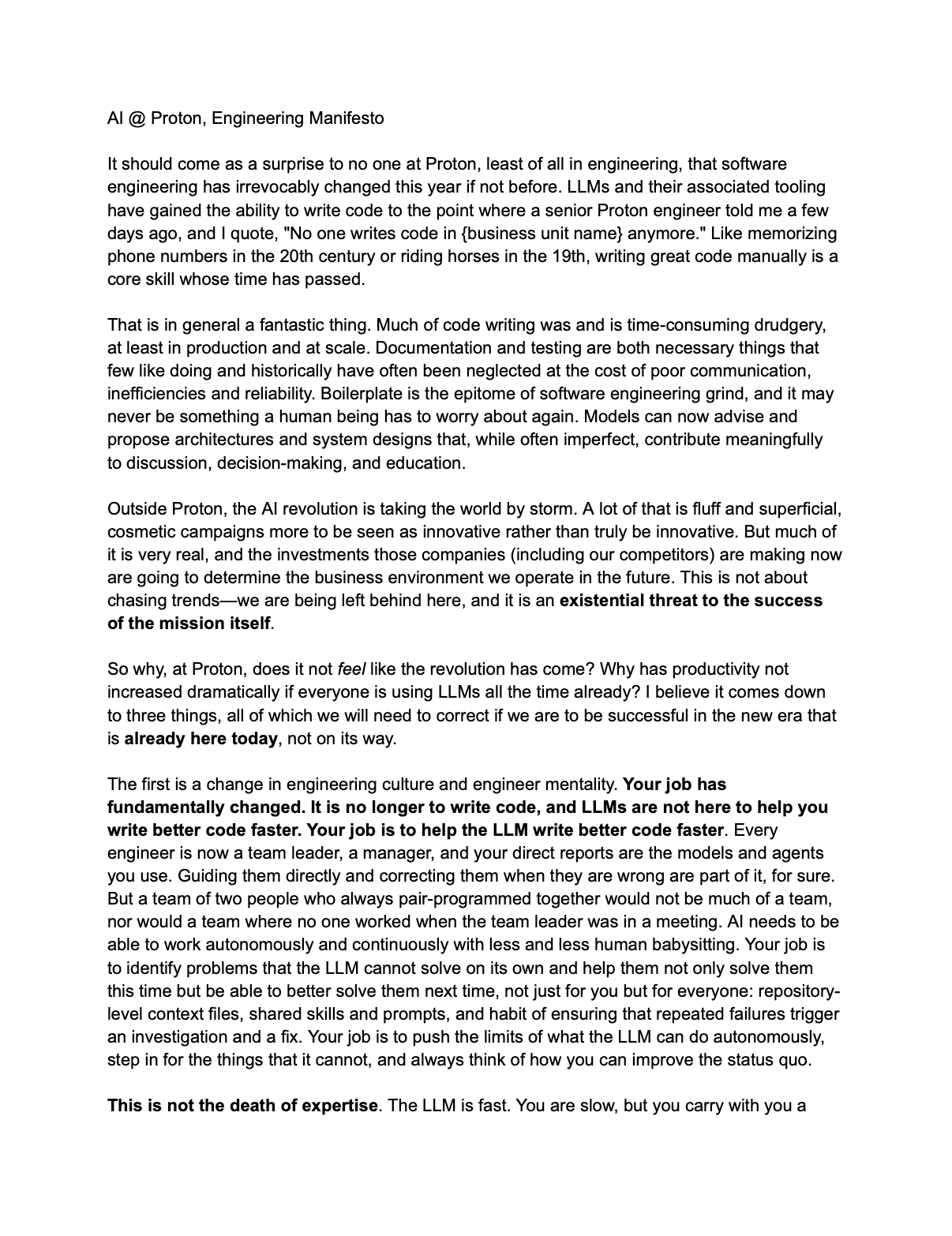
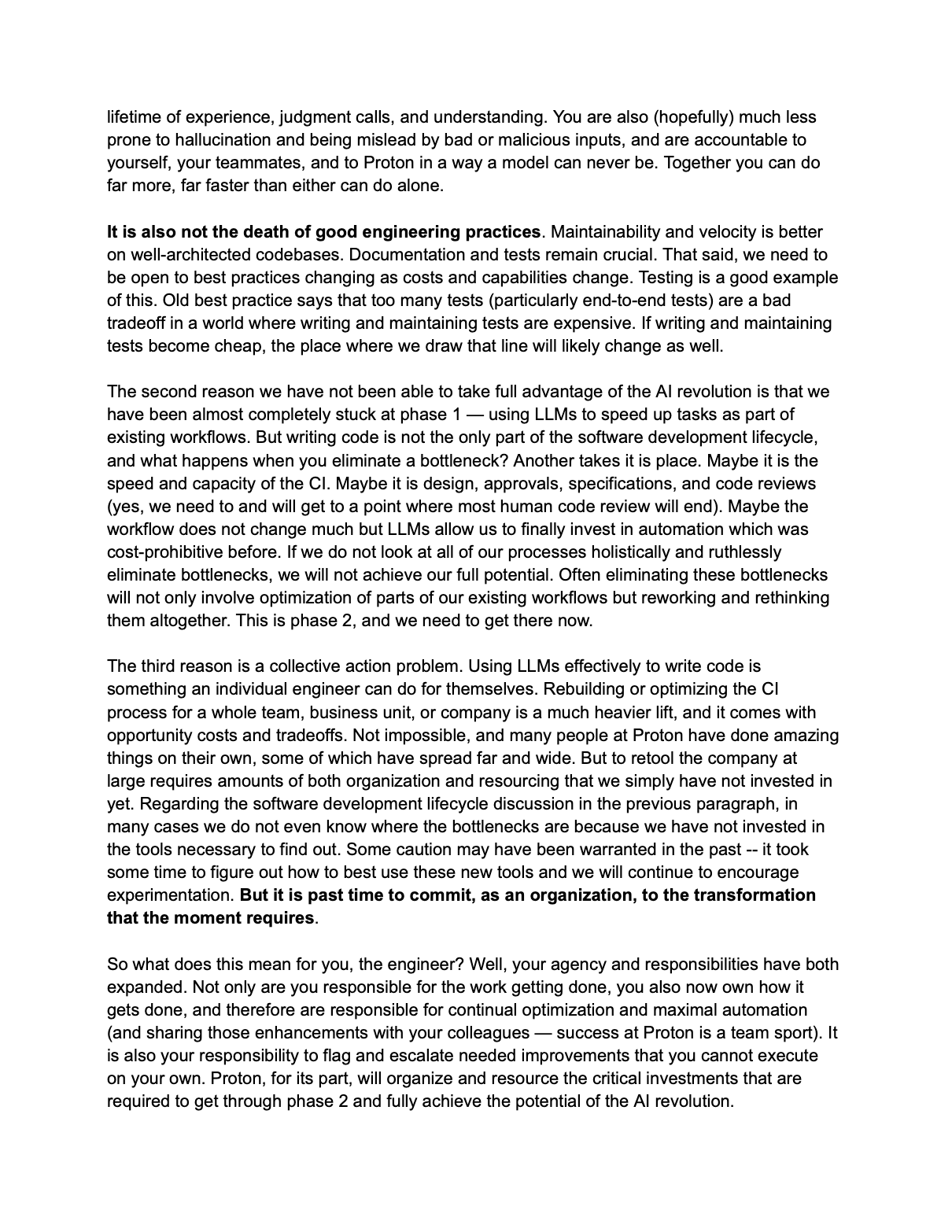
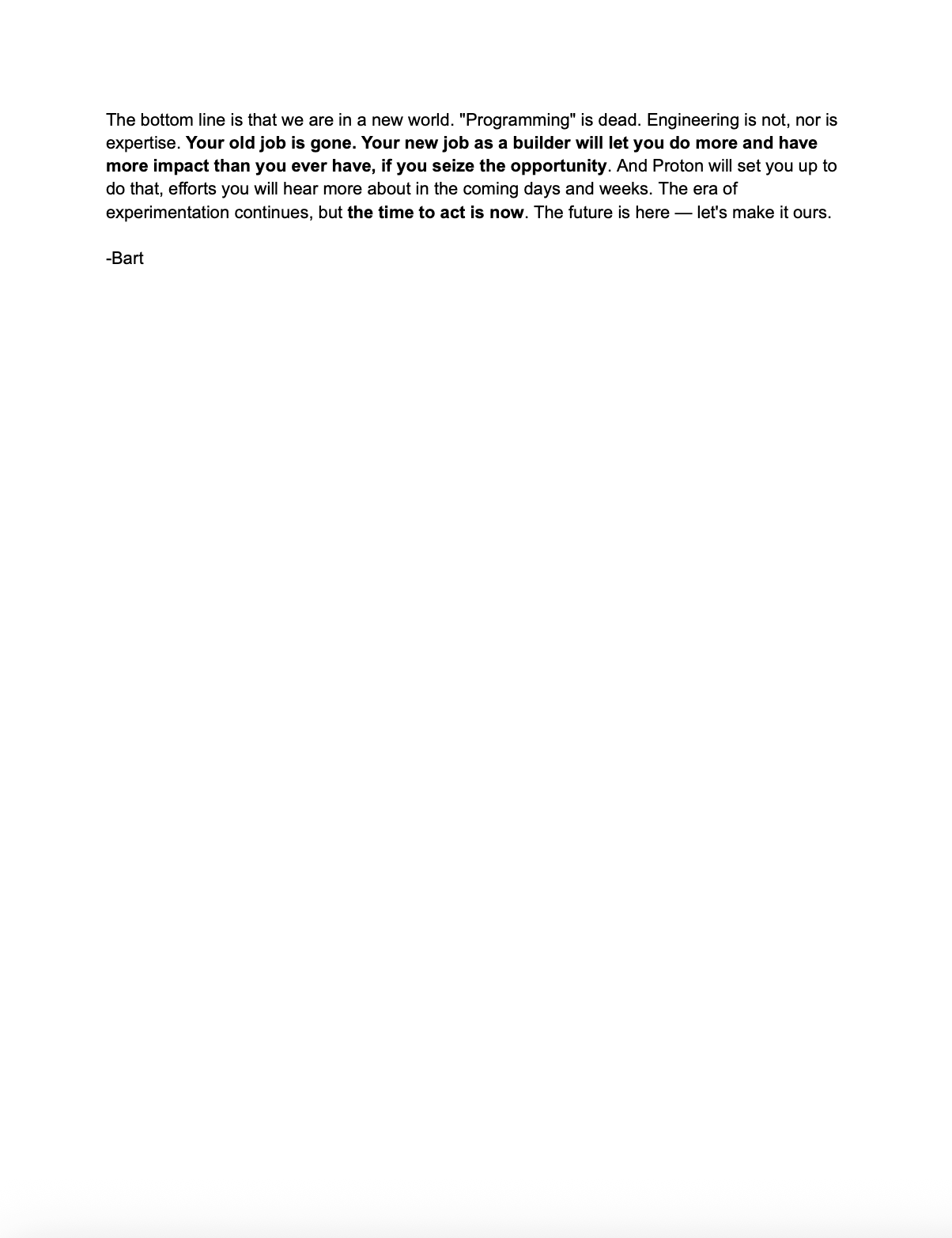
Butler's AI manifesto, which 404 Media retyped.
One Proton employee replied in Slack, “Perhaps scaring people with: We are in a new world. ‘Programming’ is dead [...] your old job is gone wasn’t really necessary on a Friday afternoon.”
Butler replied, “It’s supposed to be provocative, because it needs to be. I suggest you read it, think about it over the weekend, and come with your questions to me on Monday rather than on Slack. Thanks!”
An employee told 404 Media, “People were surprised and somewhat cringed out, since the document clearly exaggerates what you can do with LLMs today and doesn't address any of the problems you get in return for giving up your code base to the AI Jesus (e.g. AI cannot really maintain a large code base over time).” Another called it “ethically bankrupt.”
Earlier this week, Proton sent the email to employees saying they would re-interview workers about how they use AI in their jobs. The tone was clear; you may lose your job because of these interviews, current employees told 404 Media. “These re-interviews are consequential,” the email read. Soon after, a senior employee spoke up in Slack to Yen about the re-interviewing process. He suggested instead that Proton detect who is falling behind and support them and enforce high quality training.
Yen’s response was blunt: “Let’s put it this way, we already know more or less who is behind. If we were giving up on them, we would not bother with this process.”
The employee replied, “That messaging is fear-based. Which is probably why I suspect there are dozens of other employees watching us talk about this live and except for [other employee] no one else is chiming in.”
“People shouldn’t be scared to talk about this in public and to push back on you and leadership. A fear based culture feels like a cancer to me. It’s the opposite of engineering, you need to talk about things, even uncomfortable things,” they added. Yen eventually told the employee, in front of everyone: “If you are making the accusation that this is a financially driven decision and you don’t trust me when I tell you it’s not, then I think this might not be the place for you.”

Only one other employee chimed in during that exchange: “It’s about the culture you instil, people don’t want to feel like they’re on a tightrope, and yes we understand you want to move fast but there needs to be a balance, people also need support, not everyone is the same.”
“It was also faster for my parents to beat me until I ate my vegetables but I’m not sure it was healthy,” they added.
The exchange with Yen was unusual not only in that someone was debating some of Yen’s ideas, but also that it directly referenced the culture of fear at Proton. “Whenever someone talks back to Andy it tends to be highlighted since very few people talk back to him,” one employee told 404 Media.
Proton sources described that culture in various ways to 404 Media. One said, “People just shut up and get on with things.” Another added, “Most have just given up. Your expertise will be undermined, you will be told to do what the CEO wants, and there’s a decent chance you’ll be called all types of stupid in the process.” A third said there is “100%” a culture of fear, especially in the last few months. “Andy [Yen] tends to not communicate; when things are communicated, it is ‘this is happening.’ Views in which he doesn’t share, he can be hostile to and will shit on people in public chats. Like even for managers… which doesn’t look very prof[essional].” A fourth said, “Andy [Yen] truly seems to hate a lot of the people that work here.”
In a meeting held after leadership sent the re-interview email, which 404 Media obtained audio of, Butler said that not everyone who received the email would in fact be re-interviewed. “So don’t freak out if you don’t receive an invite. Most of you will, but not all, just for logistical reasons and otherwise, or it’ll happen later.”
“Nobody gets a pass from this, basically,” he said, referring to how Yen had already interviewed around 40 people, including Butler. Yen also re-interviewed Eamonn Maguire, the director of engineering for AI and machine learning, he said at another point. People who scored highly in those interviews are now being tasked with interviewing other Proton employees, Butler said.
“You should not blow this off, okay? It's consequential. It's not either that you are interviewing, fighting for your life, like in some sort of Hunger Games thing,” he continued. But, “it’s an opportunity and a risk, okay? If you haven’t done anything with AI and you haven’t thought about it, you haven’t changed how you work, and you’re in product design or engineering, well, now is the time. And if you have done things and you feel confident in it, that’s good too.” A speaker in the meeting also mentioned that some people may get promoted through the re-interviews.
“I think we’ll see what the results say. But I urge you to take it seriously, but not freak out, I guess,” Butler said. “This isn’t a witch hunt,” he added. “It’s not a religion.”
As for why this push for AI is happening around, “It’s because we ran out of time,” Butler said.
“Perception is more important than truth, the truth doesn’t matter if you don’t win on perception.”
Yen’s feverish desire for Proton to radically embrace AI can be explained, at least in part, by an internal Proton document laying out the company’s intention to make something it is calling a fast team of people who will try to make the company build at a much more rapid clip. The document says Proton is not on track to achieve its annual recurring revenue target by the end of the year because of “insufficient velocity.” The company’s year-over-year growth is “far away from what the market today considers to be good,” and, “By all metrics that matter, we’re an underperforming company.”
Second, the document says Proton transitioning to an “AI-first company” requires additional time and effort before it will start to see efficiency gains. For around six months, Proton has been in an experimental phase with AI, but now the company is taking concrete steps to restructure the company around AI, according to meeting audio 404 Media obtained.
Third, the document says Proton “suffered a catastrophic 6 hour downtime which showcased to the world (and to us) that Proton’s engineering is not actually reliable and resilient. We need to quickly remedy this problem, which will also increase workload because we need to pursue these reliability improvements simultaneously with shipping features ASAP to accelerate our growth rate.” That incident was in August.
Possible solutions to make the company faster are to move to the U.S. or China, the document says, which is “not an option for Proton unfortunately,” presumably referring to being headquartered in Switzerland for its strong privacy protections. Second is firing a lot of people and then rehiring, which Proton says is unrealistic because “we are based in Europe, where firing the wrong people is slow, and hiring the right people even slower.” The third is to “transform the company from within.”
To solve some of these apparent problems, the document calls for the creation of an “elite fast team” which will demand a lot more work, including weekends. Being on the fast team offers a 30 percent increase to base salary, paid out as a monthly bonus; a company credit card employees can use to order food if working hard during weekends, upgrade a long haul flight work flight to business class, get a five star hotel when visiting another office, or take colleagues out to dinner for team building.
“This program is not for everybody. It requires a certain drive and mental toughness. We expect it to be no more than 5-10% of the company. But for the ambitious, the young (or old), or those who are simply bored, come join the team that will re-found Proton for the future,” the document says. Yen also spoke in Slack chats about Proton being a “996 company,” referring to the culture of working from 9 a.m. to 9 p.m., six days a week, a practice that started in China and is becoming popular in Silicon Valley. The extra perks and money appear to be a move to get employees to work more than their contracted hours, which is harder to implement in Europe given its strong labor laws.
“That’s bullshit and loser thinking. Of course it’s possible to be fast and secure.”
In other settings where Yen is not present, employees and managers are more open about what is going on.
In another meeting 404 Media obtained audio of, a Proton employee said they do not trust Andy’s judgement on highly technical choices. In another, even Butler said Yen doesn’t understand the technical points about the AI topics he is re-interviewing people on.
“And for those of you maybe, oh, what the fuck does Andy know about anything technical? He doesn’t, and it’s not that technical,” Butler said. “But what this approach does do, is there’s nothing like a deadline to motivate people,” he said, referring to the re-interviews.
When asked about Yen’s comments, whether there is a culture of fear in Proton, and may people be fired based on the re-interviews, a Proton spokesperson told 404 Media in an email, “Times of major change are scary, and the tech industry as a whole is contending with this transition. We have not always communicated our intentions as well as we could have, but Proton is committed to helping our colleagues retrain and reskill for the future.”
On Wednesday, Yen started a new thread in the company’s Slack in an uncharacteristically calmer tone. “When thinking about Al, it's not really about the capabilities today, but what capabilities might be possible in the future, which is probably less distant than we think. We will need to transform our org, and doing so requires knowing who is using Al well, who is mis-using Al, or who hasn't used Al at all (don't be in this group),” he wrote. For much of the day, with the November re-interviews looming, almost nobody was working on actual work and standup meetings were cancelled, one employee said.
One employee replied to Yen with Reddit posts from Proton users reacting to 404 Media’s article first breaking news of the re-interviews. “I'm paying a premium for this service and as such I demand that corners are not cut simply because some new technology of dubious means comes into existence. I want coders to understand their code. I want them to think about the problems they are trying to solve and come to those conclusions naturally. It will create a better product with reproducible results. If you want to replace some jobs replace the jobs of the people who thought this email was a good idea,” one of them pasted into Slack read.
Yen, usually concerned with what people were saying on Reddit, didn’t respond.