
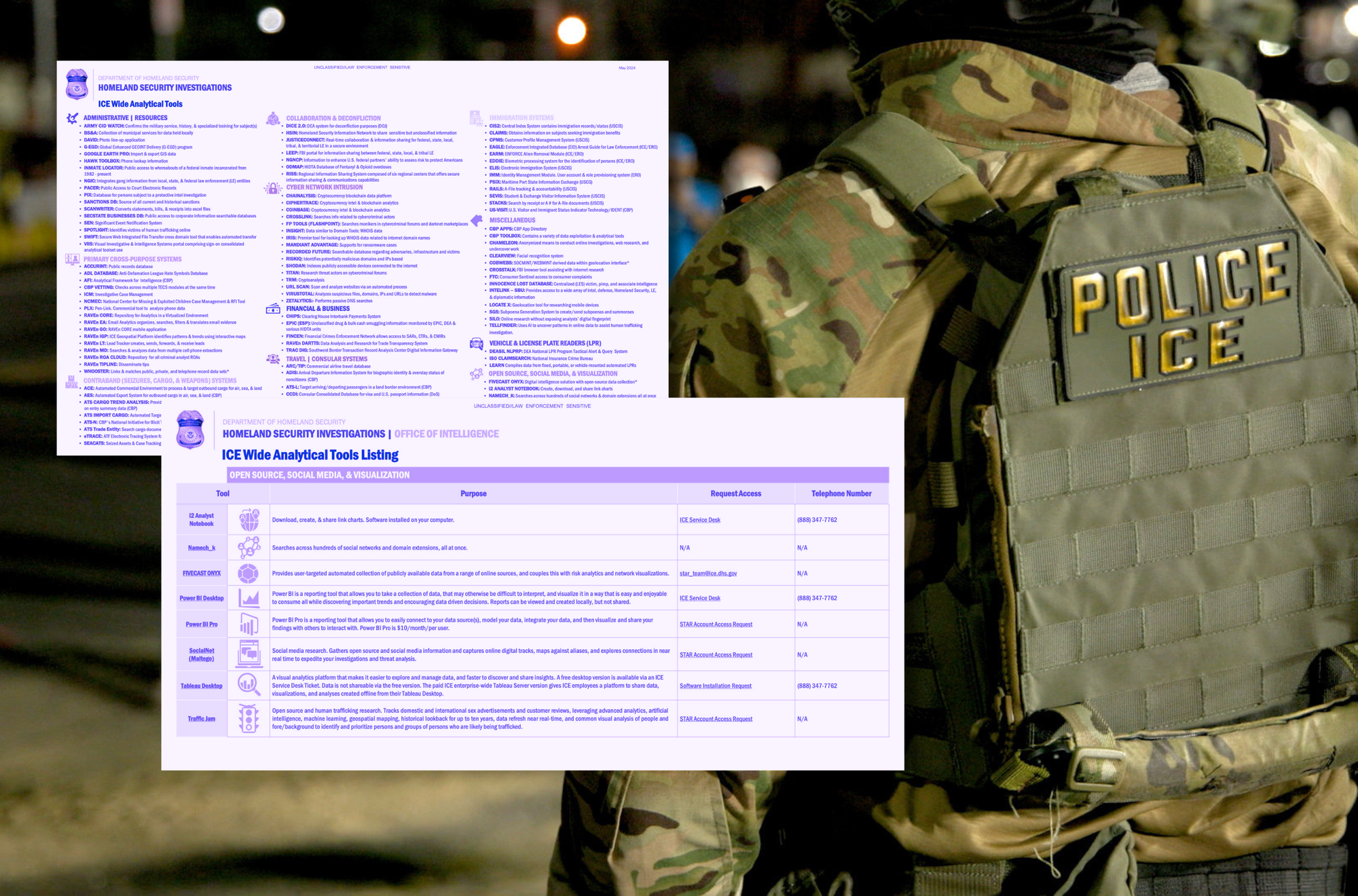
A leaked document shows the spread of surveillance and investigative capabilities that Immigration and Customs Enforcement (ICE) officials have access to agency wide, from location data harvested from smartphones, to facial recognition apps that can reveal someone’s identity, to tools that let the agency stay anonymous online and approach people undercover. The document covers everything from monitoring social media to tracking the movements of vehicles.
It is rare for the public to see such a large list of ICE’s technology capabilities in a single document. 404 Media has published the whole document, called “ICE Wide Analytical Tools,” below.
When sent screenshots of the document and asked for comment, a Department of Homeland Security (DHS) spokesperson told 404 Media “Like other law enforcement agencies, ICE employs various forms of technology to investigate criminal activity and support law enforcement efforts.”
Some notable entries in the document include:
- Accurint: a LexisNexis tool for locating people that contains all sorts of personal data like addresses, phone numbers, Social Security numbers, and more
- Chameleon: a tool which provides “Anonymized means to conduct online investigations, web research, and undercover work”
- Locate X: a tool that lets ICE search a massive database of location data harvested from smartphones. Made by Babel Street, the tool uses data sourced through ordinary apps installed on peoples’ phones or the advertising ecosystem. 404 Media previously reported how the tool could be used to track phones at abortion clinics after privacy advocates gained access to the technology. “It allows investigators to draw a digital fence around an address or area, pinpoint mobile devices that were within that area from mobile data sources,” the document reads
- Cobwebs: a social media tracking tool. 404 Media previously reported Cobwebs also includes Webloc, which can monitor phone locations in entire neighbourhoods
- ISO ClaimSearch: a database that contains property and casualty insurance claims and medical bills. The database is nearly all encompassing and contains details on more than 1.8 billion insurance claims and 58 million medical bills


Screenshots from the document.
The document is dated May 2024 so is out of date, meaning ICE may not have access to every one of these capabilities at the time of writing. ICE has continued to spend hundreds of millions of dollars on peoples’ personal data and new surveillance technology. And the document does not include surveillance or investigative capabilities only specific parts of ICE may have access to. For example, it doesn’t mention ELITE or ImmigrationOS, two Palantir-made tools that 404 Media previously revealed. Instead it mentions RAVEn, a Homeland Security Investigations (HSI) system developed in-house before the agency contracted Palantir to build a new suite of tools. RAVEn IGP, for example, is described as ICE’s “Geospatial Platform.”
“Allows identification of patterns and trends using interactive maps to view complex events through geographical locations and time. Available to all ICE employees,” the document adds.
You can see the document here.