
Advertisement
Features

I Bought the $3,000 Fitness Suit That Electrocutes You. I’m Sending It Back

Celebrities like George Clooney have praised the expensive Katalyst suit. For me, it derailed my other exercises and made me reassess my obsession with fitness and efficiency.
I Bought the $3,000 Fitness Suit That Electrocutes You. I’m Sending It Back
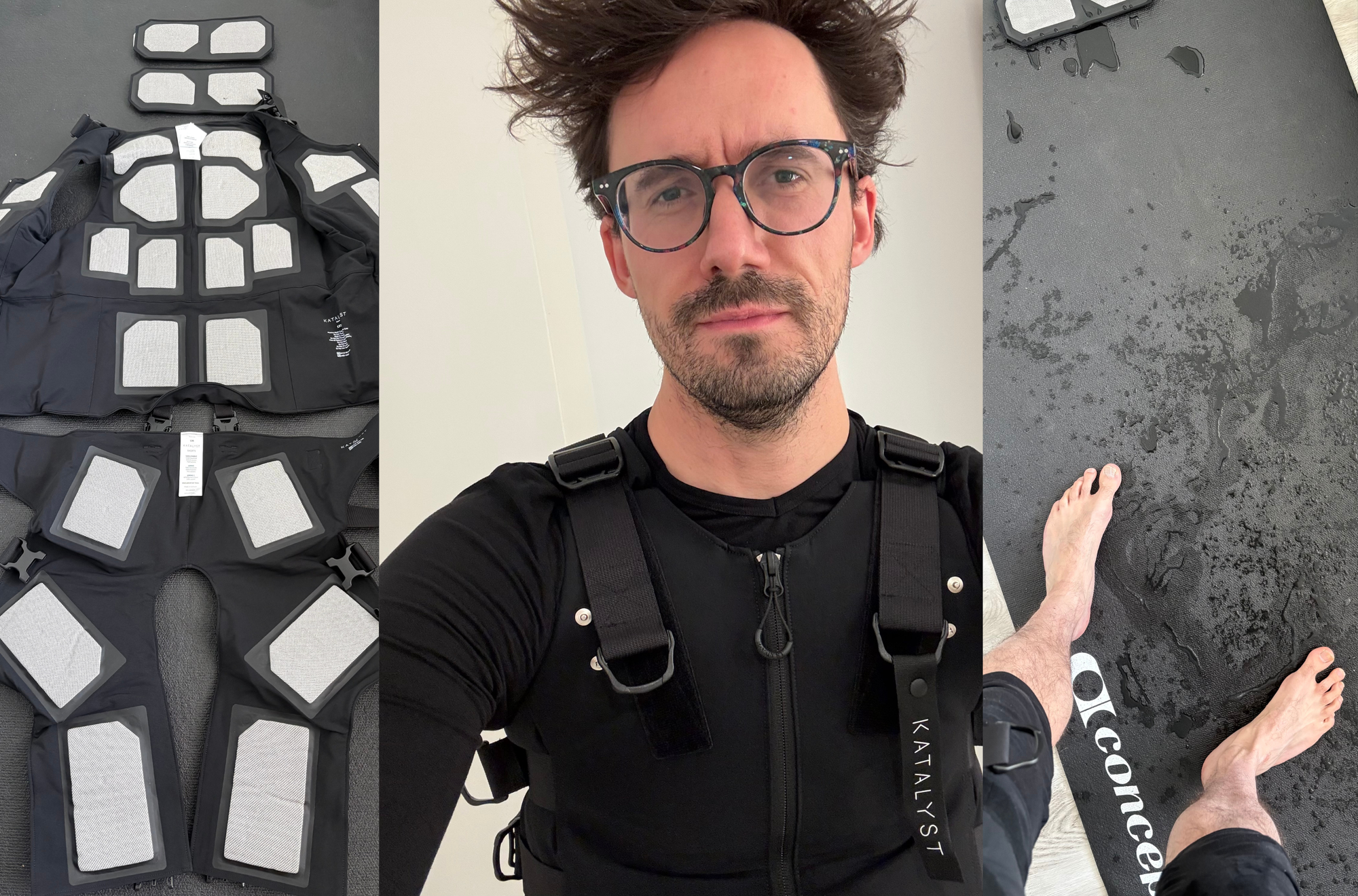
Image: 404 Media.

Putting on the $3,000 Katalyst suit is like sliding around with an electric eel. First you lay out the vest, shorts, and arm straps (on a towel if you don’t want to make a mess) and spray their electrode pads with a lot of water. “More water is better,” Katalyst’s CEO Brendan Kennedy told me. You then clip the vest and shorts together, creating a single, dripping suit. After wrapping those around your body and zipping up, you put on the arm straps and connect them to the main suit with a pair of delicate cables. You slip a battery pack into a pocket near your thigh, snap its magnetic plugs to the vests and shorts, and you’re ready to work out, soaking wet and maybe cold if you took too long to assemble the contraption.

The pitch is that Katalyst will essentially supercharge your workouts. The suit electrocutes your muscles while you do basic movements alongside a virtual instructor in the accompanying app. Think lunges, squats, and the movement of a deadlift. You can get the equivalent of a 2 hour strength session in just 20 minutes, Katalyst says. George Clooney has praised the suit, telling Esquire “my arms are twice the size they’ve ever been. It’s crazy.” Bloomberg Businessweek has covered the suit too, writing, “here’s the thing: The Katalyst suit worked.”

I already own a bunch of exercise and wellness tech, from smart swimming goggles to the Oura ring. I often plan my workout time as efficiently as I can. That’s one reason why my main form of exercise is rowing, which uses a lot of muscles at once, and why I sometimes wear resistance gloves during swimming to squeeze out as much benefit as possible. So, as a tool that promised super-efficient sessions even if the price tag is obviously insane, I really wanted to like Katalyst. I thought it might be the secret to finally branching out from rowing and swimming to more strength-focused routines.

But it wasn’t. It gave me pins and needles in my feet for days at a time and made my limbs numb and cold, derailed my other workouts, and it simply wasn’t fun in the way good and long-lasting exercise habits ideally should be. Instead, slipping into the $3,000 cyber suit for around a month made me reassess my obsession with fitness, optimization, and efficiency. It made me consider which of those concepts were actually helping me, and which were ultimately holding me back. What the fuck am I even doing? I eventually thought to myself, dripping water all over my apartment floor.

I wasn’t the only one. “Legit you are the craziest person I know,” 404 Media’s Emanuel Maiberg said after I sent a photo of the soaking wet suit to our group chat. They compared me to an Infinite Jest character, with Sam Cole saying “we’re laughing IRL over here.” Jason Koebler added: “As your friends and colleagues and cofounders. This is not normal. The bit has gone too far.” 

Katalyst is an electro muscle stimulation, or EMS, suit. The pads send electrical pulses that make your muscles contract. At first, as the suit and app ramp you into a workout, the pulses feel like a light tingling sensation. Then, a solid block of electricity across your arms, legs, and abs. You wet the pads, and sometimes the base layer of shorts and a long-sleeve t-shirt, because the water helps conductivity between the electrode and your skin, Katalyst says.

“That was absolutely insane,” I texted the rest of 404 Media after my first workout.

At some points, your limbs may lock in place due to the intensity of the blast. I tweaked my settings so I could complete the movements fully and with a good amount of difficulty and resistance, while not completing locking my legs or arms out. The app encourages and makes this easy to do: during a workout there are buttons in the app you can quickly press to increase or turn down the intensity of the pulses. The instructor in the pre-recorded video will often bring up the power during the workout to reach an electrocuting crescendo. It can take a few of the recommended three or so workouts a week to find your ideal baseline.

Katalyst’s instructors recommend you breathe out while the suit pulses. You perform a squat, or a lunge, or another movement for four seconds while the suit shocks you. Then you rest for four seconds. You keep doing that through different motions and intensities. In 20 minutes, the workout is over. 

This timesave is obviously the big attraction of the Katalyst; the idea that you can somehow squeeze hours of work into mere minutes without even leaving your home. “I'd been trying to go back to the gym a dozen times over the preceding 2-3 years with no luck. The time savings/mental ease of EMS training really is a blessing,” AustinAfter40, a YouTuber who makes EMS-related videos, told me in an email. Within the first few months of getting an EMS suit in 2023, Austin says he gained 10 pounds of muscle. In the years since that’s gone up to 20 pounds, without, Austin says, really touching anything heavier than a 15lb dumbbell. “My bone density has increased significantly, body fat has lowered, and back pain I've dealt with much of my life is now a distant memory,” he says.

If you scroll the Katalyst subreddit, you find many people saying much the same thing. But navigating the world of EMS can feel like the Wild West. Austin makes money from his EMS-related videos with affiliate links, so viewers need to keep that in mind when watching whatever suit he is currently making videos about even if the information is sincere and helpful (he has since moved onto TitanBody, a Katalyst competitor). The intensity and metrics of EMS suits are not standardized, so you don’t really know what you’re getting. An intensity rating of, say, 200 on a Katalyst is probably not going to be the same on a TitanBody suit. Or a VisionBody suit. Or any of the other EMS suit companies that have clearly bought Google Search ad space when you look for anything EMS-related. 

Katalyst is FDA-cleared. That is not the same as FDA-approved. The Katalyst suit falls into Class II of the FDA’s different groups for devices, putting it in the moderate risk category. Being cleared means Katalyst can sell the suit, but the FDA is not saying everyone should slip it on.  

On the Katalyst subreddit, people have historically complained about the company’s customer service or suit delivery times (the customer service was very good for me, with a dedicated Zoom call to talk through the issues I was facing). Kennedy, through his company Mont y Mer, acquired Katalyst in 2025. He said the previous CEO and Katalyst’s founder, Bjoern Woltermann, had “essentially bankrupted the company twice in six years,” and had taken orders and payment from more than 1,000 customers but hadn’t created any suits. Kennedy said he then went around the world meeting with different suppliers to produce those original 1,000 suits. For me, it took around five months for my suit to arrive when I ordered it in 2025. Kennedy said Katalyst has inventory now and has “sort of solved that problem.” Woltermann acknowledged a request for comment but did not provide a response in time for publication.

Beyond the anecdotal, the science suggests EMS suits can work. Professor Yong-Seok Jee at Hanseo University, who has researched EMS, told me in an email that while athletes often use EMS to target specific muscle groups, he says the suits can also help normal people. Like me, presumably. “For non-athletes or the general population, EMS can be particularly useful as a time-efficient and low-impact training option, especially for beginners, older adults, or individuals with limited mobility,” he continued. 

But EMS is not some magic tool you can use instead of actually working out and exercising normally. “That said, EMS is not a shortcut or replacement for exercise. Its effectiveness depends heavily on appropriate intensity, supervision, and program design, and there are safety considerations (e.g., avoiding excessive stimulation),” Jee said.

Casey Johnston, who runs the lifting-focused newsletter She’s a Beast and author of A Physical Education, told me in an email Katalyst is “definitely in no way a replacement or even effective complement to strength training.” 

“If anything, similar to the drag suit argument, wearing a thing like the Katalyst would probably hamper your ability to effectively learn strength training movements and form, which is a huge cornerstone of translating strength to real life, before it would be additive in any meaningful way with, I can't put enough quotes, ‘muscle stimulation,’ or whatever term they use,” she added.     

“This suit looks like the biggest scam I’ve ever seen,” Johnston wrote. She pointed to the Relaxacisor, a device from 1949 that blasted your abs with electrical pulses. “This thing is no different, and equally scammy,” Johnston said.

I didn’t want to replace my current exercise regime of rowing and swimming five or six times a week with the Katalyst. I wanted to slot it in. I’ve repeatedly injured myself with various strength routines, to the point where I’ve had to do physical therapy and had medical procedures done, so I wanted Katalyst to supplement my existing exercise and get more strength in there. That didn’t work.

First, obviously, you ache after blasting yourself with electricity. So much so that you (wisely) need to rest, but also so much so that you can’t then row or swim, even at a lower level. So I found myself not doing the two forms of exercise I love and get great joy from and which have drastically improved my health over the years. 

Next, I started to essentially injure myself with the suit. I often got pins and needles in my hands and feet. One of the instructors in the app said pins and needles in your hands can happen and should go away quickly. But mine would last for hours, and my feet multiple days. Then my limbs would feel numb and I would be incredibly cold, so much I would start sneezing. Kennedy told me getting pins and needles for this long was “extremely abnormal.” I took his advice of wetting the pads even more, and even the base layer you put on. I also did some workouts without the arms turned on at all. That stopped the issue with my hands at least.

But it still wasn’t working for me, mentally. It made me think what was I even doing this for. To be efficient for efficiency’s sake? 

There is something lost when you favor efficiency above all else. You lose the joy of just moving in a way that feels good. You lose embracing the process of exercise itself when trying to make the time spent as short as possible. You lose sight of your actual goal with exercise, which for me is to keep active and healthy, not get insanely jacked. You lose that state of everything fading away, your mind clearing, endorphins flowing, and nothing else existing but your body moving without you even thinking about it. What runners call the runners’ high, or what I get in rowing when I’m on a longer workout. Maybe some people do get that or feel good with EMS suits. The in-app instructors said you might. I know I didn’t get it with Katalyst.

Advertisement