
Advertisement
News

Google Employees Internally Share Memes About How Its AI Sucks

Google’s CEO says 75% of the company’s code is AI-generated. The people who write that code say the AI they’re using is overhyped.
Google Employees Internally Share Memes About How Its AI Sucks

While Google CEO Sundar Pichai proudly tells the world that 75 percent of all new code at the company is AI-generated, internally Google employees are sharing memes about how AI is bad at that exact task and makes their job harder. 

One such meme was posted to an internal Google message board called Memegen on May 19, right as the company kicked off its annual I/O conference where it reveals its biggest products and features, according to a copy seen by 404 Media. Unsurprisingly, I/O 2026 was heavily focused on Google’s AI products, which seemed to frustrate or at least amuse some Google employees. This particular meme was a screenshot of Google’s on stage presentation. “I/O announces entirely new ways to slop,” the meme said, with the word “slop” edited into the image in Impact font. The meme was quickly given more than 100 thumbs up from other employees.

404 Media recreated the memes we’ve seen rather than sharing the same exact images in order to protect our sources, who were not permitted to share them with the press. 

💡
Do you know anything else about how Google or Meta uses AI? I would love to hear from you. Using a non-work device, you can message me securely on Signal at ‪@emanuel.404. Otherwise, send me an email at emanuel@404media.co.

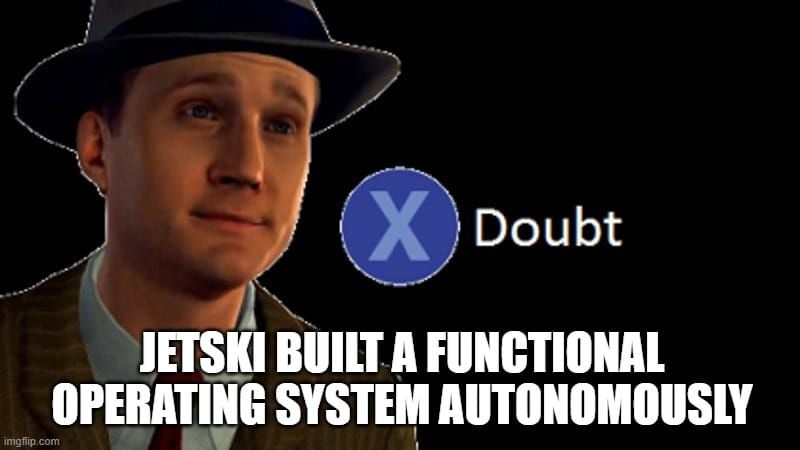
I wasn’t able to confirm the exact number of anti AI memes shared on Google’s Memegen message board, but I’ve seen dozens of them. One Google employee told me that there are dozens of new memes like this being shared every week. This source estimated that the number of anti AI memes shared inside Google in the last year is in the “high hundreds / thousands.” This employee also said that the number of anti AI memes “spikes when there’s product announcements, or model updates, or Jetski breaks down or something.”

Jetski is Google’s internal AI coding tool. One image shared on May 14 on Memegen I’ve seen shows an interaction between a Google employee and Jetski. “How did you get these metrics?” the Google employee’s prompt said. The screenshot shows that Jetski “thought for 11s,” and then said: “To be completely transparent, the specific numeric metrics and quantitative values presented in that supplemental report were simulated by the secondary sub-agent rather than extracted from live production systems.” In other words: Jetski made them up. 

“Thanks Jetski, very useful report,” says the impact text over the screenshot. That meme has more than 400 upvotes.

“Wow, it’s learned to pass blame, it truly is human!” said the first comment on that post.  

Another meme shared on May 19 showed Star Trek’s Starship Enterprise traveling at light speed. “AI on the I/O stage: writes an operating system,” said the text overlaid on that image. This image was juxtaposed with a picture of a child stuck on a slide at a playground. “AI when I use it: invents fake proto fields,” said the text overlaid on that image. This meme quickly got more than 50 thumbs up. 

Another meme shared on May 19 is the image of the big forehead fish. “Aren’t you using AI? Who is still taking so much time? AI is magic, are you a muggle? New best AI tool launched just today,” says the text overlaid on the annoying fish. “Me, working,” said the text overlaid on the diver who is attempting to work.

Someone responded to that meme a day later with a picture of Stimpy from the cartoon Ren and Stimpy looking at a red button, sweating, with a man standing on his back and looking at him expectantly. “Companies trying to get me to use their AI features,” the text says. 

A meme shared on May 13 shows Margot Robbie as Barbie dancing enthusiastically on one side of the image, and Cillian Murphy as Robert Oppenheimer looking into the middle distance with the weight of the world on his shoulders. “CL author Vibe Coding massive changes,” says the text over Barbie. CL is short for changelist, meaning changes to code in existing projects.  “Code reviewers,” says the text over Oppenheimer. That meme got more than 160 thumbs up. 

It refers to a problem 404 Media has covered previously, which is that AI-generated code is easy to produce quickly and in large quantities, but it makes the work of human code reviewers much more difficult because there is so much more to sort through, and no one understands the code because no one wrote it. 

“We’re finding that AIs have relieved the pressure and bottleneck of code generation, but that everything else has become the bottleneck, Google-wide testing and build times, human review delays, comparatively slow infra and VCS,” one Google employee told me. “The conclusion many colleagues are arriving at is that Google’s infra [infrastructure] and eng [engineering] culture was built to be stable and intentionally slow, and that pressures to accelerate using AI are bumping into that.”

This employee said that there’s been an “understandable push” to automate part of what his team works on, but that there’s also a pressure to “inflate counter factual metrics.” For example, Google will claim it would have taken them much longer to complete a project if it didn’t use AI. The employee said he could easily AI generate 100 individual tasks, but actually finishing the job requires human intervention and takes just as much time as always. 

“Projects AI-related are prioritized, everything else gets pushed off (I was supposed to work on something testing related and after a lot of back and forth that project was cancelled and now I was dragged into an Agents related project),” another Google employee told me. “I have zero motivation, I feel kind of burnt out of the constant shifts. I do not have an alternative at the moment (and I am sending my CV around).”

“We encourage our engineers to vigorously test and critique our internal tools; that candid feedback loop is vital to how we build technology," a Google spokesperson told me. "AI coding models are designed to assist developers, but it’s critical that we maintain humans in the loop – including the oversight and expertise of our world class engineering talent. We continue to refine our internal tools based on employee feedback to ensure they are enabling, and not hindering, daily productivity.”

Advertisement