
Welcome back to the Abstract! Here are the studies this week that felt the heat, left their mark, survived a cataclysm, and watched cows watch TV.
First, the bones of long-dead whalers are spilling out their Arctic graves due to human-driven climate change. Then: a trip to “where the snakes lost life,” an ur-moon in the ashes, and the facial recognition abilities of cows.
As always, for more of my work, check out my book First Contact: The Story of Our Obsession with Aliens or subscribe to my personal newsletter the BeX Files.
The thaw at “Corpse Point”
The battered bones of beleaguered whalers buried centuries ago in the Arctic are melting out of their permafrost graves due to human-driven climate change, according to a new study. The remains of these men, who lived in the 17th and 18th centuries, reveal the physical toll of whaling on sailors, and highlight the urgent need to preserve cultural heritage as global temperatures rise.
Climate change is an obvious danger to future generations, but it also threatens our link to the past by accelerating the erosion and degradation of its material remains. This problem affects all kinds of different archaeological sites, from ancient artifacts preserved in vanishing Mongolian glaciers to the oldest rock art on record in Indonesia, which is rapidly decaying in the heat 45,000 years after it was painted.

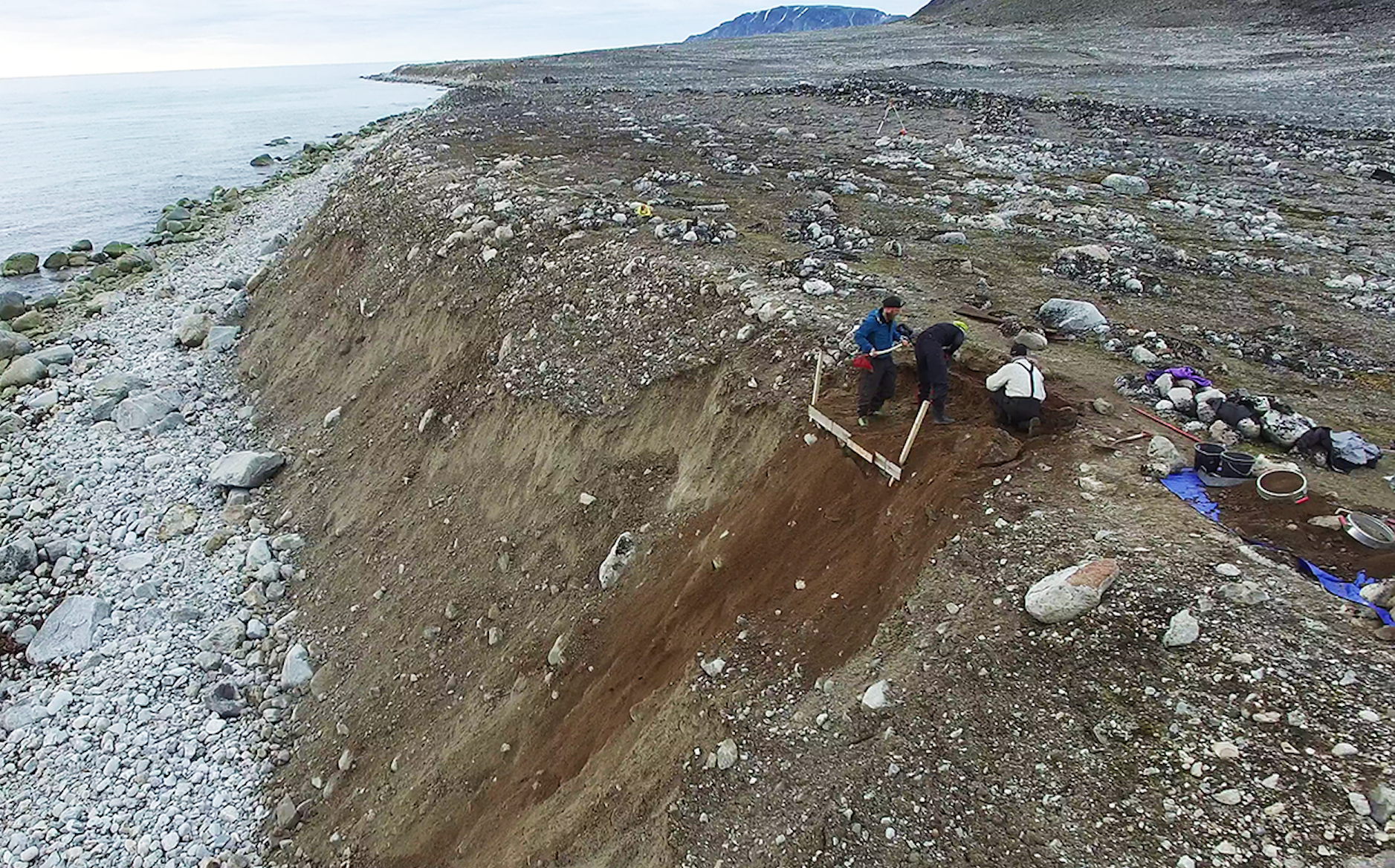
Nowhere is more affected by warming trends than the Arctic, where temperatures are rising nearly four times faster than the global average. Now, a pair of researchers has examined the remains of European whalers at the Likneset whaling burial site on Norway’s Svalbard archipelago, also known as “Corpse Point.” The team discovered significant degradation of many burials since they were first documented in the 1970s, a loss that has been sped up by climate change.
“The site has been excavated repeatedly over more than three decades, providing a rare opportunity to examine both preservation change and human skeletal evidence through time and across contrasting burial environments within a single site,” said authors Lise Loktu of the Norwegian Institute for Cultural Heritage Research and Elin Therese Brødholt of Oslo University Hospital.
“In several cases, coffin lids had collapsed and sideboards were displaced, resulting in partial disturbance of skeletal remains and textiles,” the team said. “One grave (Grave 214) is classified as completely destroyed, with coffin elements and skeletal remains dispersed downslope.”

These whalers just can’t get any peace, even in death. Their lives were short and filled with physical hardships, according to the team’s re-examination of the bones. Many individuals endured physical trauma due to chronic strain, and 18 out of 19 of the studied sailors suffered from scurvy. Most of the bones belong to men who died in their 20s or early 30s.
“The predominance of healed injuries indicates survival after traumatic events and suggests that mortality within the assemblage was more closely related to cumulative physiological stress than to acute fatal trauma,” according to the study.
“The results from Likneset…call into question the long-term viability of in situ preservation and managed decay under warming permafrost conditions,” the team concluded. Future work to address this problem “should be guided by clearly defined knowledge priorities: which information must be documented and analysed before it is irretrievably lost?”
In other news…
The mystery of Ndalambiri
For at least 45,000 years, humans have gathered at Ndalambiri, a rockshelter in Angola thought to be named for an Umbundu phrase that means, “This is where snakes lost life.” Its interior wall is adorned with an immense fresco of roughly 1,200 figures painted in white, red, and black, including many anthropomorphic and geometric designs left over the past 2,000 years.
Now, researchers report the first comprehensive excavation of the site in partnership with local communities, an effort that unearthed thousands of artifacts, such as pottery shards, tools, and botanical and faunal remains.

“The archaeological content of this central rock art and heritage site in Angola has remained poorly documented until now,” said researchers led by Isis Mesfin of the French Museum of Natural History in Paris. “The diversity of archaeological materials discovered at the Ndalambiri shelter makes it a strategic site for raising awareness about heritage preservation and field archaeology training.”
The team discovered the earliest evidence of iron production in Angola in the layers, dating back to the 5th century CE, and speculated that Ndalambiri was often a crossroads of diverse cultural interactions. But despite the wealth of new finds from the excavation, the study noted that “the identity of Ndalambiri’s occupants and painters remains uncertain.”
Though it’s not clear yet who adorned its walls or sought refuge in its space, the rockshelter was clearly a storied gathering place that preserves eerie remnants of untold generations.
Last moon standing
Belyakov, Matthew et al. “Nereid as a regular satellite of Neptune.” Science Advances.
Let’s dispense with human timescales and wind the clock way back to the early solar system, some four billion years ago. There was Neptune, minding its own business, when a pair of Pluto-sized dwarf planets suddenly barged into its way, causing complete orbital chaos.
Neptune gravitationally captured one of the interlopers, which became the moon Triton. But in the fallout of the encounter, Neptune’s original moons were catapulted into deep space or torn into pieces and left to coalesce into a new set of irregular objects.
All, that is, except Nereid. Scientists have discovered that this Neptunian moon, which is about 200 miles in diameter, is likely the sole survivor of this ancient collision of worlds. Using observations from the James Webb Space Telescope, a team found that Nereid doesn’t spectrally match the rest of Neptune’s moons.
“Our proposed regular satellite genesis story for the moon leaves Nereid as the singular intact original satellite of Neptune—Neptune’s innermost moons, such as Proteus, are reaccreted pieces of satellites destroyed by Triton’s capture,” said researchers led by Matthew Belyakov at Caltech. “Future spacecraft exploration of the Neptunian system should search for signs of an early geologic history on Nereid consistent with formation as a regular satellite.”
Talk about a lunar loner. Nereid may offer a rare glimpse of a fleeting era before Triton came crashing into its captured orbit, upending the Neptunian moon system forever.
Cows can tell people apart
We’ll end, as all things should, with cows watching TV. To determine whether these animals can recognize human faces, or match voices to faces, scientists played a series of videos for 32 Prim’Holstein cows.
In one experiment, the cows watched a series of muted videos of familiar and unfamiliar male faces. In a second session, the cows watched videos of familiar caretakers speaking in their own voice, or a dubbed version with a different voice. The heart rates of the cows were monitored throughout both experiments.

The results revealed that “cows looked significantly longer at the unfamiliar person, suggesting that they are able to discriminate between familiar and unfamiliar individuals using only a video of their faces as a cue,” said researchers led by Océane Amichaud of the National Research Institute for Agriculture, Food and Environment in France. “Cows looked significantly longer at the face that matched the voice, indicating that they are able to associate familiar and unfamiliar voices with the corresponding face.”
While the cows were able to distinguish between individuals, there was no difference in their heart rates when presented with familiar caretakers and strangers. The researchers suggested that future work should explore whether any other bovine behaviors are dependent on their human companions. This has been “cows watching TV” news.
Thanks for reading! See you next week.