Advertisement
News

AI Grifters Are Making Anti-Data Center Slop With AI

There are hundreds of anti-data center Facebook pages churning out AI-generated slopaganda.
AI Grifters Are Making Anti-Data Center Slop With AI
Images via Facebook.

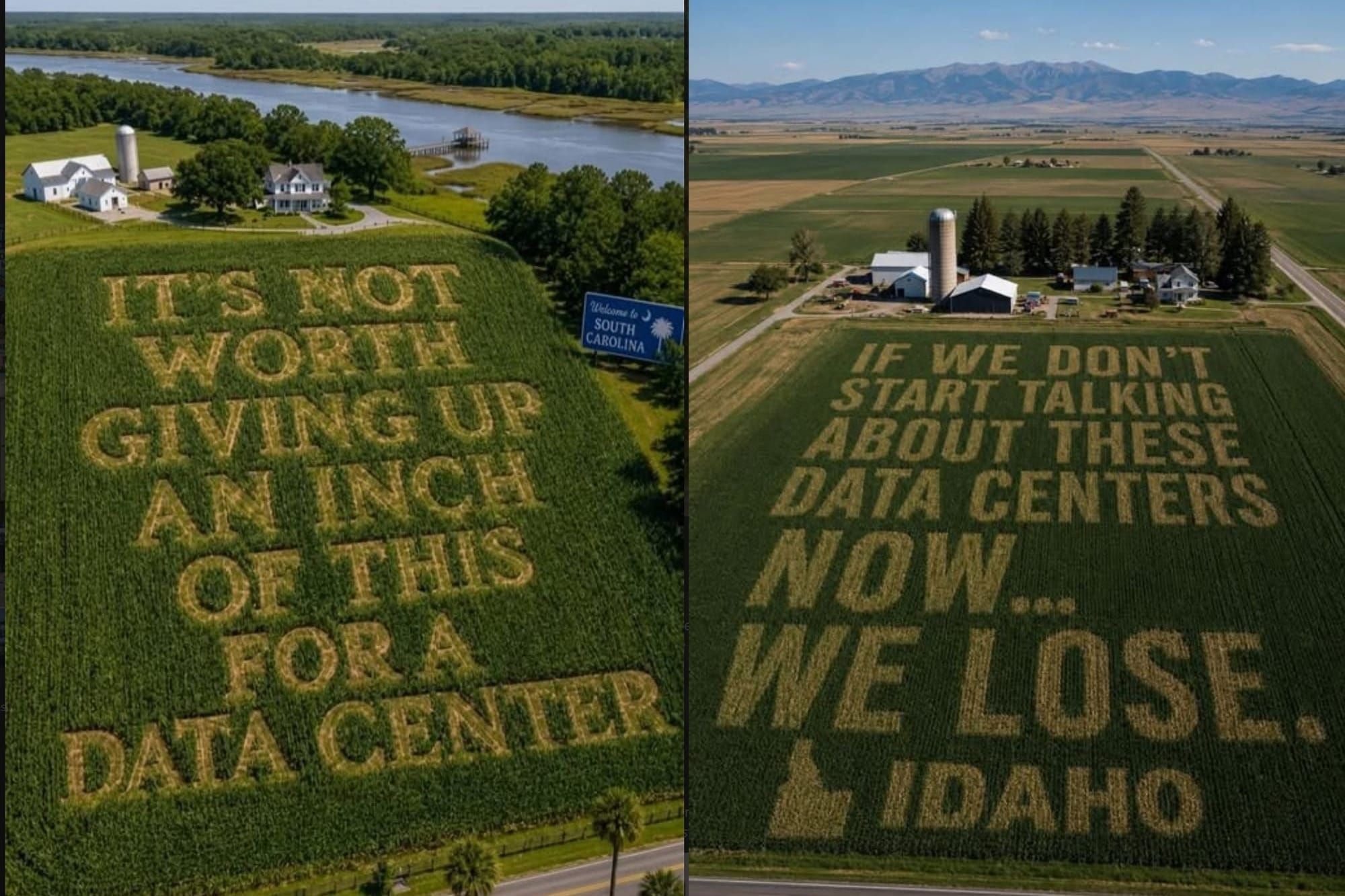
If you want a barometer of American political concerns you could do worse than checking what spam accounts are turning into AI-generated slop on Facebook. There are now hundreds of pages with names like “Life in Texas," “History of Wisconsin,” and “Life Is Idaho" churning out dozens of AI-generated images playing into anti-data center sentiment across the country.

One of the most ubiquitous styles of anti-data center slop I’ve seen is a vast tract of farm land with a message like “not worth giving up an inch of this to a data center” mowed into it. The image is tailored to fit the target audience in each state. “Our great lakes. Our forests. Our communities. Our future,” said the Michigan version in the field surrounded by a massive lake and a water tower that helpfully read “Michigan.” The Kentucky version repeated the message but added “bluegrass, bourbon, and horses. Kentucky” to the mowed grass.

The caption of the post explained that a rural farmer in the state mowed the letters into their field as a form of protest against proposed data centers. There are hundreds of these pages, all themed around life in individual states, sharing similar versions of the same images. “Wow. According to FB, every farmer in every state has done this. Enough with the AI,” said a comment below one of the images on the “Life in Kentucky” Facebook page.

People hate data centers. Local and state communities around the country are passing moratoriums on their construction. Data centers are noisy and their neighbors have pressing concerns about water use, increased electricity bills, and the quality of the jobs developers are promising to create. Some areas, like Ypsilanti Township where the University of Michigan is planning a large data center, are even worried about becoming targets in future wars. These anxieties are now the focus of AI spam farms on Facebook. 

This is the same algorithmically boosted “shrimp Jesus” style AI spam scheme we’ve reported on before. There are people, some of them in foreign countries, who churn out hundreds of AI-generated images across multiple pages to engage users and turn a profit on ads and links. It’s impossible to know who, exactly, is putting up all these state-themed anti-AI pages. I reached out to several of the pages through Facebook Messenger but got no response. Many of the pages provide the same contact email but I didn’t receive a response when I contacted it.

What’s clear is that the people who study American culture and profit from selling it back to Americans via Facebook have figured out there’s profit in sharing content about how much we hate data centers. Many of the images I found had been liked thousands of times and shared hundreds more. Comments under the slop ranged from staunch support of the anti-data center movement to anger that AI housed in a data center had been used to create anti-data center propaganda.

Like all AI slop, these Facebook pages aren’t great with the facts. The “Fans of Alabama Crimson Tide” shared an AI-generated image of a woman standing in farmland at sunset. The Alabama flag rippled in the wind behind her. “An Alabama mother and daughter turned down $26 million to prevent their 1,200 acre farm from being converted into an AI data center,” the caption said. The Facebook post didn’t name the woman or provide details but she’s real and her name is Delsia Bare and the story is mostly true. She and her mother turned down a $26 million dollar offer to build a data center on their farmland. The data center would have been 2,000 acres not 1,200. Also, this all happened in Kentucky, not Alabama.

An AI spammer took Bare’s story and her image, which appeared to come from local news coverage of her case, then repurposed it as a piece of anti-AI content to generate engagement from football fans in a different state. “Whether you agree with the decision or not, one thing is undeniable — standing firm against a $26 million offer takes incredible conviction. Alabama pride runs deep, and this story is another reminder that for many families, their land is more than property… it’s home,” said the caption on the Facebook page. As of this writing, the post had generated 56 likes and been shared 5 times.

“This was in Kentucky wasn’t it?” said a comment in the replies.

The people organizing against data centers have noticed the tide of slop. “Across the country, we’re hearing from local officials in conservative and liberal areas that their community can finally unite behind one thing—opposing the expansion of data centers,” Michael Whitesides, deputy communications director of Local Progress, a nonprofit that works with election officials at the local level, told 404 Media.

“AI slop usually followed a very predictable pattern. They’re either designed to provoke intense reactions to play to a very middle of the road audience. The fact that Facebook content farms have switched to producing AI-generated images opposing data centers shows just how universal and uncontroversial this opposition is,” Whitesides added. “The irony shouldn’t be lost that said images are being created with the help of data centers, but all the more underscores what local elected officials here all across the country—no one wants these.”

That’s not entirely true. There’s a lot of billionaires, contacts, and other monied interests in America that are bullish on data centers. Construction of these massive computer warehouses is driving the American economy. Think tanks like Brookings have published massive studies calling the build out a “gold rush.”

But the people who live in the communities where data centers are going up do not want them. They’re noisy, drive up the costs of electricity and water for neighbors, and disrupt the beauty of the natural landscape. Local, state, and national resistance to the construction of the data centers is building and it seems to have caught some of the boosters and investors by surprise.

A counter-narrative to the backlash is building. American law enforcement is warning about anti-tech extremism centered around the data center resistance movement. A Congressional intelligence agency is tracking “recent threats and attacks likely linked to grievances concerning data centers,” according to reporting from Ken Klippenstein. Billionaire Canadian TV Star Kevin O’Leary, shocked by opposition to his $70 billion data center in Utah, is laying the blame on China.

“There’s a war going on, I guess a PR war or whatever you want to call it,” O’Leary said in a recent video posted to X.

“Is what you’re suggesting that these entities are taking funds from the Chinese Communist Party and using those funds to run a digital blackmail campaign against your project?” someone off camera asked O’Leary.

“I’m not suggesting it, it’s an irrefutable fact,’ O’Leary said.

Data centers are going to be one of the major political issues in America for the next few election cycles. Battle lines are being drawn and narratives are taking shape. And in the middle of it all are people using AI to do what it does best: boiling the human experience down into cheap slop so it can be served back to us.

Another version of the Bare story got the facts correct, but removed her and her family from the picture. “Family rejects $26 million offer for their Kentucky land amid AI data center plan. A clash between tradition and technology,” text said above an AI-generated image of a middle aged couple in denim with dirty blond hair and Taylor Sheridan-TV show good looks. This couple that does not exist stares into the camera, clutching two children tight.

Bare, the real person who rejected the $26 million buyout, is not mentioned or pictured.

Advertisement